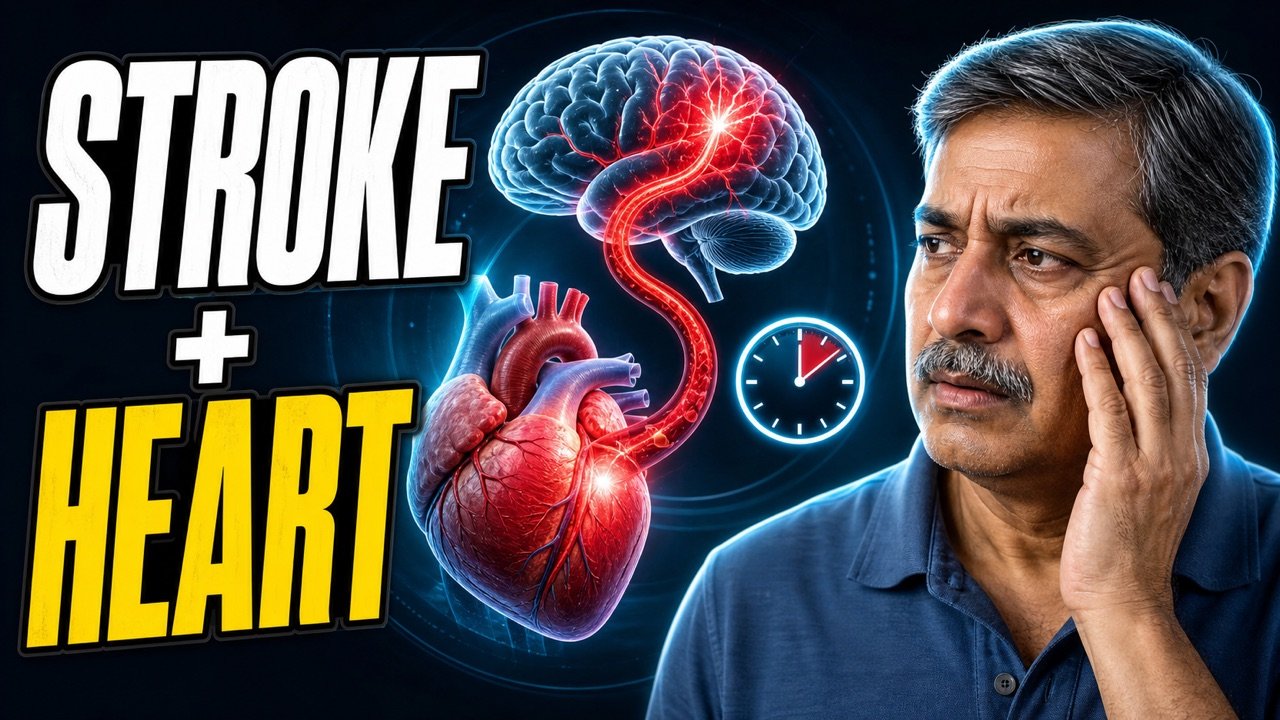
In short: Stroke and heart disease share the same roots — high blood pressure, high cholesterol, diabetes and smoking — and conditions like atrial fibrillation can send clots to the brain. A stroke is a brain emergency: remember FAST (Face drooping, Arm weakness, Speech difficulty, Time to call for help). One prevention plan protects both heart and brain.
Key takeaways
- Heart and brain share the same risk factors.
- Atrial fibrillation is a major cause of stroke.
- Stroke is a time-critical emergency — remember FAST (Face, Arm, Speech, Time).
- One prevention plan protects both organs.
- Controlling blood pressure is the single biggest lever.
Heart and brain may seem like separate concerns, but they are deeply connected — they share the same blood vessels, the same risk factors, and often the same underlying disease. The HHIF patient story of someone who faced diabetes, stroke and bypass surgery captures this vividly: these conditions are branches of the same tree. Understanding the link between stroke and heart disease helps patients and caregivers protect both, and recognise an emergency when it strikes.
This article draws on the Heart Health India Foundation discussion Defying All Odds: A Patient’s Journey Through Diabetes, Stroke and Bypass Surgery. New to these topics? Start with our guide to understanding heart health.
How stroke and heart disease are connected
Both stroke and heart disease are largely caused by the same process: the gradual narrowing and damaging of arteries by high blood pressure, high cholesterol, diabetes, smoking and other risk factors. When this affects the arteries feeding the heart, it causes heart attacks; when it affects the arteries feeding the brain, it causes strokes. So the very habits and conditions that threaten your heart also threaten your brain.
There is a second, more direct link through the heart’s rhythm. Atrial fibrillation — an irregular heartbeat we cover in atrial fibrillation and palpitations — allows blood to pool and form clots in the heart, which can travel to the brain and cause a stroke. This is why diagnosing and treating atrial fibrillation, often with blood thinners, is one of the most important things we can do to prevent stroke.
Two kinds of stroke
A stroke happens when blood flow to part of the brain is interrupted. Most strokes are ischaemic — caused by a clot blocking a brain artery, much like a heart attack in the brain. A smaller proportion are haemorrhagic — caused by a blood vessel bursting, often linked to uncontrolled high blood pressure. Both are emergencies, and both are powerfully linked to the cardiovascular risk factors we can control.
Recognise a stroke FAST
Just as with a heart attack, minutes matter enormously in stroke — fast treatment saves brain tissue and function. A simple way to remember the warning signs is FAST: Face drooping on one side; Arm weakness (one arm drifts down); Speech difficulty (slurred or strange speech); Time to call for emergency help immediately. Other signs include sudden numbness (especially on one side), sudden confusion, trouble seeing, severe sudden headache, or loss of balance. As with heart attack warning signs, the rule is to act immediately and never wait to “see if it passes.”
Protecting your heart and brain together
The wonderful efficiency of prevention is that one set of habits protects both organs at once. Control blood pressure — the single biggest risk factor for stroke (see high blood pressure: the silent killer). Manage diabetes (diabetes and heart disease) and cholesterol (beating bad cholesterol). Don’t smoke (smoking and your heart). Stay active, eat well, maintain a healthy weight, limit alcohol, and if you have atrial fibrillation, take prescribed treatment to prevent clots. Regular screening catches the silent risks early. Every step you take for your heart is also a step for your brain.
Acting FAST and supporting recovery
Because brain tissue dies quickly during a stroke, the response must be immediate, and the FAST check makes it memorable: Face drooping, Arm weakness, Speech difficulty, Time to call for emergency help. Do not wait to see if symptoms pass, do not lie down to “sleep it off,” and do not drive yourself — call for help and get to a hospital equipped for stroke care as fast as possible, because clot-dissolving and clot-removing treatments are most effective within a narrow early window. Note the time symptoms started, as this guides treatment. After a stroke, recovery and prevention go hand in hand: rehabilitation rebuilds function, while aggressive control of blood pressure, cholesterol, diabetes and (where present) atrial fibrillation prevents the next event. Families are central to both, helping with medicines, appointments, rehabilitation and emotional support, much as we describe in caregiving for a heart patient. The encouraging thread running through all of this is that the same vigilance and habits that protect against stroke also protect the heart — so the effort you invest is doubly rewarded, guarding both the organ that pumps and the organ that thinks.
What the research says
According to PubMed, a review of cardiovascular risk factors and prevention (Teo and Rafiq, Canadian Journal of Cardiology, 2021) highlights that two large international studies — INTERHEART and INTERSTROKE — found that around nine to ten common, largely modifiable risk factors accounted for more than 90% of the risk of heart attack and stroke respectively, and that lowering blood pressure, blood glucose and lipids reduces subsequent illness and death. In other words, most strokes and heart attacks share the same preventable causes. A further review on atrial fibrillation and stroke (Elsheikh and colleagues, Current Problems in Cardiology, 2023) underscores the importance of detecting atrial fibrillation early to prevent stroke.
Recovering after a stroke — and protecting the heart too
For families touched by stroke, recovery raises its own questions, and the heart remains central throughout. After a stroke, rehabilitation — physiotherapy, speech therapy, occupational therapy — helps rebuild function, much as cardiac rehabilitation helps after a heart event. But just as important is aggressive prevention of the next event, because someone who has had one stroke (or a “mini-stroke,” a transient ischaemic attack) is at higher risk of another, and often of heart disease too, since the underlying artery disease is shared. This means controlling blood pressure, cholesterol and diabetes, not smoking, staying active, and — if atrial fibrillation is present — taking prescribed blood thinners reliably. The heart and brain must be protected together.
Caregivers play a vital role here, helping manage medicines, appointments and rehabilitation while supporting emotional recovery, which can be hard after a stroke. Our guide to caregiving for a heart patient applies closely to stroke caregiving too.
One prevention plan protects both organs
The most empowering message about stroke and the heart is also the simplest: you do not need two separate health plans. Because heart attacks and most strokes grow from the same soil — high blood pressure, unhealthy cholesterol, diabetes, smoking, obesity, inactivity and poor diet — a single, coherent set of healthy habits and treatments protects both your heart and your brain at the same time. Every time you take your blood-pressure medicine, choose a heart-healthy meal (heart-healthy Indian cooking), go for a walk, or attend a check-up, you are investing in both organs. This is why HHIF frames prevention holistically: caring for your cardiovascular system is caring for your whole self, head to toe.
What patients and caregivers ask
Largely, yes. Heart disease and stroke share most of the same risk factors, so controlling blood pressure, cholesterol, diabetes and smoking protects both your heart and your brain.
Remember FAST: Face drooping, Arm weakness, Speech difficulty, Time to call for help. Any sudden one-sided weakness, numbness, confusion or speech trouble is an emergency — act immediately.
In atrial fibrillation, blood can pool and clot in the heart; a clot can travel to the brain and block an artery, causing a stroke. Treating atrial fibrillation, often with blood thinners, greatly reduces this risk.
Not exactly, but they’re close cousins. A heart attack blocks blood flow to heart muscle; an ischaemic stroke blocks blood flow to the brain. Both are usually caused by the same artery disease.
No. Diabetes strongly raises the risk of both stroke and heart disease by damaging blood vessels. Managing diabetes well protects the brain and the heart together.
A transient ischaemic attack (TIA), or ‘mini-stroke’, causes stroke-like symptoms that resolve quickly. It is a serious warning sign of higher future stroke risk and must be evaluated urgently — never dismissed just because the symptoms passed.
Strokes are more common with age, but they can occur in younger people, sometimes due to specific causes. Anyone with sudden FAST symptoms — at any age — needs emergency care immediately.
Yes, very much so. Recovering well is wonderful, but the risk of another stroke or a heart event remains because the underlying artery disease persists. Continuing medicines, controlling blood pressure, cholesterol and diabetes, and attending follow-ups are exactly what prevent a second event — feeling better is a reason to keep going, not to stop.
High blood pressure is the single biggest modifiable risk factor for stroke, so controlling it is especially powerful — but it works best alongside managing cholesterol, diabetes, smoking, weight and, where present, atrial fibrillation. Together these protect both brain and heart.
The bottom line on heart and brain
Stroke and heart disease are branches of the same tree, growing from the same soil of high blood pressure, unhealthy cholesterol, diabetes, smoking, obesity and inactivity — with the heart’s rhythm, through atrial fibrillation, adding a direct route from heart to brain. This shared origin is, in fact, empowering: it means a single, coherent set of healthy habits and treatments protects both organs at once. Every blood-pressure tablet taken, every heart-healthy meal, every walk, every check-up, and every prescribed blood thinner for atrial fibrillation guards your brain as surely as your heart. And when a stroke does strike, the same urgency that applies to a heart attack applies here: recognise it FAST — Face, Arm, Speech, Time — and get emergency help immediately, because fast treatment saves brain tissue and function. For families, the caregiving and prevention that support a heart patient apply just as fully to a stroke survivor. The message running through it all is hopeful: most strokes and heart attacks share the same preventable causes, so the effort you invest in your cardiovascular health is doubly rewarded. Protect the organ that pumps and you also protect the organ that thinks, remembers and makes you who you are.
References (peer-reviewed)
Sources retrieved from PubMed:
Teo KK, Rafiq T. Cardiovascular Risk Factors and Prevention: A Perspective From Developing Countries. Can J Cardiol. 2021;37(5):733–743.
Elsheikh S, Hill A, Irving G, Lip GYH, Abdul-Rahim AH. Atrial fibrillation and stroke: State-of-the-art and future directions. Curr Probl Cardiol. 2023;49(1):102181.
Join the HHIF Heart Health Community
Protecting your heart and brain together is easier with reliable guidance and a community that understands. You don’t have to do it alone.
Heart disease is India’s number one killer, and stroke is a leading cause of disability — yet both are largely preventable. That’s why patient communities matter: they spread the knowledge and support that prevent tragedies.
The Heart Health India Foundation (HHIF) is India’s first patient-led heart health organisation. Members get real-time guidance from cardiologists and other experts, myth-busting content, awareness resources, webinars and a supportive community. Joining takes about two minutes, connects you to our WhatsApp and Facebook communities, and is 100% free, forever.
Join the HHIF Heart Health Community today »
Medical disclaimer
This article is for general education and awareness and is not a substitute for professional medical advice. Always consult a qualified doctor about your own heart health and before starting, stopping or changing any medication. If you or someone near you may be having a heart attack or other medical emergency, seek emergency care immediately.
Related reading from Heart Health India Foundation
- Why “I don’t feel symptoms” becomes dangerous
- Why some Indians don’t respond to BP medicines
- Why reducing salt is essential for heart health
- How early detection saves lives
- Understanding heart health: the basics