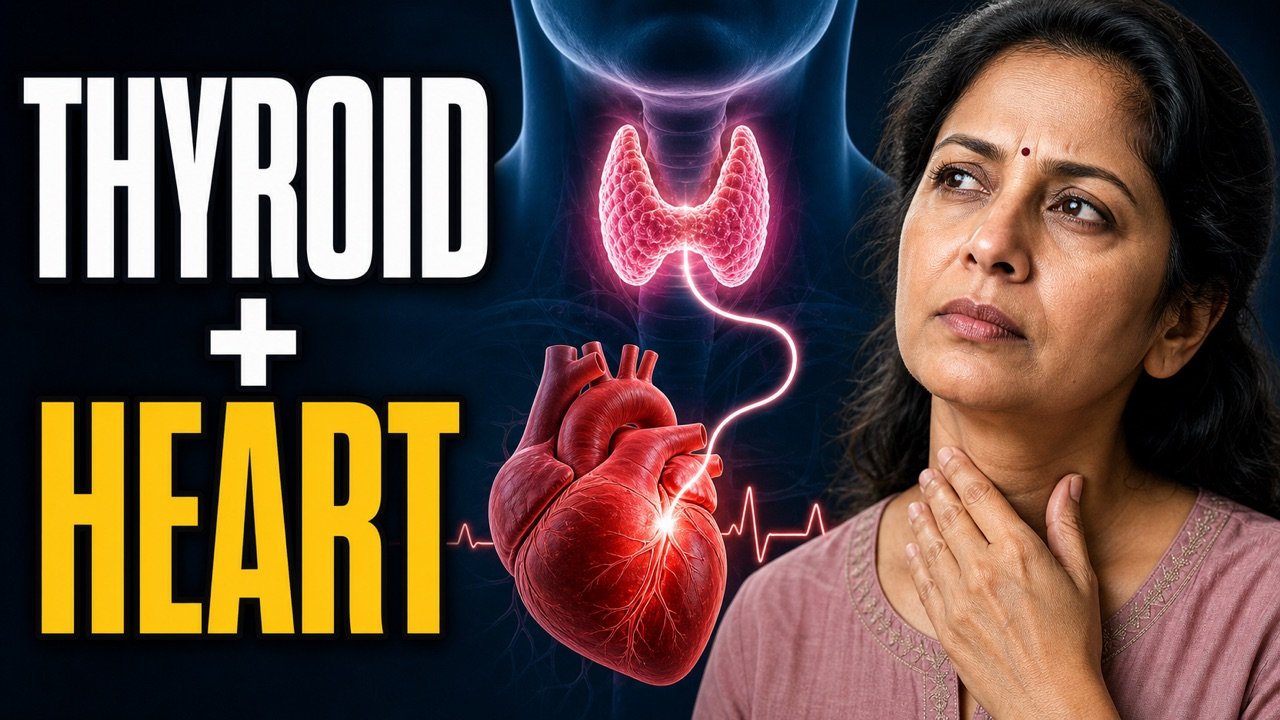
In short: Your thyroid gland helps set the pace of your heart. An underactive thyroid (hypothyroidism) can raise cholesterol and slow the heart; an overactive thyroid (hyperthyroidism) can cause a fast or irregular heartbeat and palpitations. Both are common, often missed, and treatable — so thyroid testing is worth discussing if you have unexplained cholesterol, blood-pressure or rhythm changes.
Key takeaways
- The thyroid helps set the heart’s pace.
- Hypothyroidism (underactive) raises cholesterol and can slow the heart.
- Hyperthyroidism (overactive) speeds the heart and can trigger palpitations or AFib.
- Thyroid problems are common in India and often under-diagnosed.
- A simple blood test (TSH) can reveal them — they’re treatable.
Thyroid problems are extremely common in India, especially among women — and many people who carefully manage their thyroid never realise it has anything to do with their heart. Yet the small, butterfly-shaped thyroid gland in your neck has a powerful influence on how your heart beats, how hard it works, and even on your cholesterol. This article explains the thyroid–heart connection in plain language, so patients and caregivers can ask the right questions and protect both.
This article draws on the Heart Health India Foundation discussion How Diabetes, Poor Diet & Hypothyroidism Impact Your Heart Health. New to these topics? Start with our guide to understanding heart health.
How the thyroid drives the heart
The thyroid produces hormones that set the body’s metabolic “pace,” and the heart is highly sensitive to that pace. When the thyroid is underactive (hypothyroidism), everything slows: the heart may beat more slowly, blood pressure patterns can change, and — importantly — cholesterol tends to rise, because thyroid hormone helps the body clear LDL (“bad”) cholesterol. Hypothyroidism is also associated with other cardiovascular risk factors. When the thyroid is overactive (hyperthyroidism), the opposite happens: the heart races, may beat irregularly (including atrial fibrillation, discussed in our article on atrial fibrillation and palpitations), and works harder than it should.
In other words, a thyroid that is out of balance quietly nudges several heart risk factors in the wrong direction. This is why thyroid and heart health should be considered together, not in separate silos.
Hypothyroidism, cholesterol and the Indian context
For many Indian patients, the most relevant link is between an underactive thyroid and cholesterol. Because hypothyroidism raises LDL cholesterol, an undiagnosed or under-treated thyroid can be a hidden contributor to the high cholesterol that drives heart disease — a topic we cover in beating bad cholesterol. Sometimes, treating the thyroid improves the cholesterol picture. This is one reason doctors may check thyroid function when investigating high cholesterol or unexplained cardiovascular risk, particularly given how common thyroid disorders are in India and especially among women, as we note in women and heart disease.
There is also a subtler condition called subclinical hypothyroidism, where thyroid hormone levels are still normal but the regulating hormone (TSH) is mildly elevated. Its link to heart disease is debated, and treatment decisions are individualised — which is exactly why this should be discussed with your doctor rather than self-managed.
Symptoms patients and caregivers should notice
Thyroid problems can be easy to miss because their symptoms are vague and overlap with everyday life. An underactive thyroid may cause fatigue, weight gain, feeling cold, dry skin, constipation, low mood and a slow pulse. An overactive thyroid may cause palpitations, a racing heart, weight loss, heat intolerance, anxiety, tremor and disturbed sleep. Because several of these — especially palpitations, fatigue and breathlessness — overlap with heart symptoms, they should be evaluated rather than assumed. A simple blood test can check thyroid function.
What to do about it
If you have a thyroid condition, take your thyroid medicine reliably and attend follow-ups, because both under- and over-treatment affect the heart. If you have heart disease, high cholesterol, or unexplained palpitations, it is reasonable to ask your doctor whether your thyroid has been checked. As always, the broader heart-protective habits apply — knowing your numbers through screening, eating well, staying active, and managing blood pressure and weight. Thyroid care and heart care reinforce each other.
A simple action plan for thyroid and heart health
If thyroid and heart health feel like a lot to juggle, a short action plan makes it manageable. First, if you have symptoms suggesting a thyroid problem — unexplained fatigue, weight change, feeling unusually cold or hot, a slow or racing pulse, or palpitations — or if you have high cholesterol that isn’t explained by diet, ask your doctor whether a thyroid test is appropriate; it is a simple blood test. Second, if you already have a thyroid condition, take your thyroid medicine reliably and at the same time each day, attend follow-ups for dose adjustment, and recognise that both under- and over-treatment can affect the heart. Third, keep an updated list of all your conditions and medicines so that whichever doctor you see — endocrinologist, cardiologist or family physician — has the full picture, which is especially important when several conditions coexist. Fourth, pursue the shared healthy habits that benefit thyroid, heart and metabolism together: a balanced diet, regular activity, not smoking, healthy weight, and routine screening. Finally, don’t self-manage borderline or “subclinical” thyroid results based on internet advice — these situations genuinely require individualised medical judgment. Treated sensibly, thyroid disease is very compatible with a healthy heart and a full life.
What the research says
According to PubMed, a review of levothyroxine treatment for subclinical hypothyroidism and cardiovascular disease (Sue and Leung, Frontiers in Endocrinology, 2020) notes that thyroid hormones act on the heart through multiple mechanisms and that subclinical hypothyroidism has been associated with cardiovascular risk factors such as hypertension and dyslipidaemia, while emphasising that treatment decisions should be individualised based on age, degree of TSH elevation, symptoms and cardiovascular risk. A further review (Decandia, Irish Journal of Medical Science, 2017) similarly links subclinical hypothyroidism with cardiovascular risk, especially at higher TSH levels. The patient takeaway: thyroid and heart health are connected, and individualised medical guidance matters.
How thyroid problems are found and managed
Because thyroid symptoms are vague and overlap with everyday tiredness and stress, many cases go unnoticed for years. The good news is that thyroid function is checked with a simple, inexpensive blood test (typically TSH, with thyroid hormone levels as needed). If you have unexplained high cholesterol, a slow or fast heartbeat, persistent fatigue, or are being assessed for heart risk, it is reasonable to ask whether your thyroid has been tested — particularly given how common thyroid disorders are in India, especially among women.
Treatment is usually straightforward and effective. An underactive thyroid is typically treated with a daily thyroid hormone replacement tablet, taken consistently, with periodic blood tests to fine-tune the dose. An overactive thyroid has its own treatments. The key from a heart perspective is balance: both under-treatment and over-treatment can affect the heart, so take your thyroid medicine reliably and attend follow-ups, just as you would with any heart medicine.
Two conditions, one connected body
The thyroid–heart link is a perfect example of why HHIF encourages a whole-person view of health rather than treating each organ in isolation. The same patient may be juggling thyroid disease, cholesterol, blood pressure and blood sugar — and these conditions interact. An underactive thyroid can worsen cholesterol; diabetes and thyroid disease often coexist; and an overactive thyroid can trigger the irregular rhythm we discuss in atrial fibrillation and palpitations. Rather than feeling overwhelmed by multiple diagnoses, it helps to see them as connected threads that respond to coordinated care: keep an updated list of all your conditions and medicines, make sure one doctor has the full picture, and pursue the shared healthy habits — good diet, activity, not smoking, and regular screening — that benefit your whole body at once.
What patients and caregivers ask
Yes. An underactive thyroid can raise cholesterol and slow the heart, while an overactive thyroid can cause a fast or irregular heartbeat. Thyroid balance genuinely influences heart health.
It’s possible. Hypothyroidism raises LDL cholesterol, so an undiagnosed or under-treated thyroid can contribute. Ask your doctor whether a thyroid test is appropriate.
It could be either, and the two can overlap. Palpitations should be evaluated; a thyroid test is often part of that work-up, alongside a heart assessment.
Not worry, but be aware. Take your thyroid medicine reliably, attend follow-ups, and keep up general heart-protective habits and screening. Well-managed thyroid disease is much kinder to the heart.
In some cases, correcting an underactive thyroid improves cholesterol and other factors. Treatment, especially for milder (subclinical) cases, should be individualised with your doctor.
Sometimes correcting an underactive thyroid improves cholesterol, but many people still need cholesterol treatment. Don’t stop any medicine on your own — let your doctor reassess your numbers after your thyroid is well controlled and adjust treatment accordingly.
For most people, yes, but timing and interactions matter. Keep an updated list of everything you take and share it with each doctor and pharmacist, so your full regimen is reviewed for any interactions.
The bottom line on thyroid and heart
The thyroid–heart connection is a reminder that the body works as a connected whole, not a set of separate parts. A thyroid that is out of balance quietly nudges several heart risk factors in the wrong direction — an underactive gland can raise cholesterol and slow the heart, while an overactive one can speed it up and disturb its rhythm. For Indian patients, especially women, where thyroid disorders are common, this matters more than most people realise. The good news is that thyroid problems are easy to test for with a simple blood test and usually straightforward to treat, and that good thyroid balance is kind to the heart. If you have unexplained high cholesterol, palpitations, persistent fatigue, or are assessing your heart risk, it is reasonable to ask whether your thyroid has been checked. If you already have a thyroid condition, take your medicine reliably, attend follow-ups, and keep one doctor aware of your full picture, particularly when several conditions coexist. Above all, pursue the shared healthy habits — balanced diet, activity, not smoking, healthy weight and regular screening — that benefit your thyroid, heart and whole body at once. Treated sensibly and viewed as part of a connected system, thyroid disease is very compatible with a long, healthy, heart-strong life.
References (peer-reviewed)
Sources retrieved from PubMed:
Sue LY, Leung AM. Levothyroxine for the Treatment of Subclinical Hypothyroidism and Cardiovascular Disease. Front Endocrinol (Lausanne). 2020;11:591588.
Decandia F. Risk factors for cardiovascular disease in subclinical hypothyroidism. Ir J Med Sci. 2017;187(1):39–43.
Join the HHIF Heart Health Community
Understanding how conditions like thyroid disease connect to your heart is easier with expert guidance and a supportive community. You don’t have to piece it together alone.
Heart disease is India’s number one killer, and hidden contributors like thyroid disorders often go unrecognised. That’s why patient communities matter: they connect the dots with reliable, expert-backed information.
The Heart Health India Foundation (HHIF) is India’s first patient-led heart health organisation. Members get real-time guidance from cardiologists and other experts, myth-busting content, webinars and resources, and a caring community. Joining takes about two minutes, connects you to our WhatsApp and Facebook communities, and is 100% free, forever.
Join the HHIF Heart Health Community today »
Medical disclaimer
This article is for general education and awareness and is not a substitute for professional medical advice. Always consult a qualified doctor about your own heart health and before starting, stopping or changing any medication. If you or someone near you may be having a heart attack or other medical emergency, seek emergency care immediately.
Related reading from Heart Health India Foundation
- Understanding LDL, Lp(a) and triglycerides
- Why regular heart check-ups matter even without symptoms
- Why “I don’t feel symptoms” becomes dangerous
- Lifestyle habits heart patients often ignore
- Understanding heart health: the basics