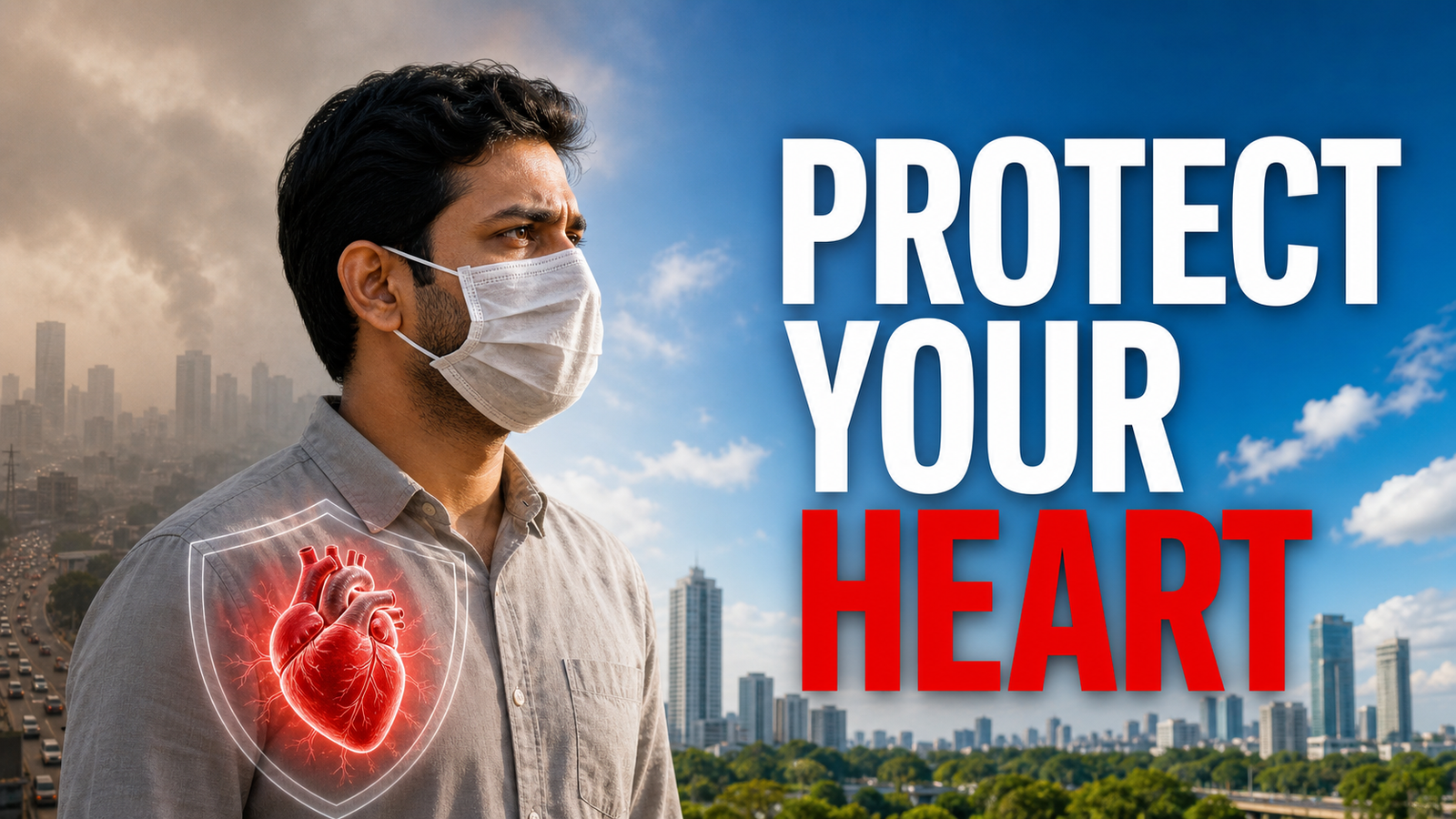
In short: Air pollution is a major, often overlooked cause of heart disease. Tiny particles (PM2.5) enter the bloodstream, driving inflammation, higher blood pressure and a greater risk of heart attacks and strokes — a serious concern in India’s polluted cities. You can’t control the air alone, but you can reduce exposure: track air quality, limit outdoor exertion on bad days, improve indoor air, and protect higher-risk family members.
Key takeaways
- Tiny PM2.5 particles reach the bloodstream and harm the heart.
- Pollution raises blood pressure, heart-attack and stroke risk.
- Indoor air matters too (cooking smoke, dust, incense).
- Higher-risk groups: heart and lung patients, the elderly, children and pregnancy.
- Cut exposure: track AQI, limit outdoor exertion on bad days, improve indoor air.
When we list heart risk factors, we usually name cholesterol, blood pressure, diabetes and smoking. But for people living in many Indian cities, there is another major risk that is literally in the air they breathe. Air pollution is increasingly recognised as a serious contributor to heart disease — yet it rarely features in everyday heart conversations. This article explains how polluted air harms your heart and, importantly, what patients, caregivers and families can do to reduce their exposure.
Explore more heart-health discussions on the Heart Health India Foundation YouTube channel. New to these topics? Start with our guide to understanding heart health.
How polluted air reaches your heart
It seems counterintuitive that breathing should affect the heart, but the link is now well established. The most harmful component is fine particulate matter known as PM2.5 — particles so tiny they penetrate deep into the lungs and pass into the bloodstream. Once there, they trigger inflammation, oxidative stress, and changes in blood vessels and blood pressure, and over time they accelerate the artery-narrowing process that underlies heart attacks and strokes. Both long-term exposure to polluted air and short-term spikes (such as during severe winter smog or near heavy traffic) are associated with increased cardiovascular events.
In effect, air pollution acts on the same pathways as the traditional risk factors we discuss across our articles — inflammation and damage to blood vessels — which is why it deserves a place in any honest conversation about heart health in India.
Why this matters so much in India
Many Indian cities experience some of the highest levels of air pollution in the world, particularly in winter months. Combined with the fact that Indians already develop heart disease earlier than many populations (as discussed in our first collection), polluted air adds an extra, population-wide burden on the heart. It is especially concerning for vulnerable groups: people who already have heart or lung disease, older adults, children, and pregnant women. This is not a reason for panic, but for awareness and sensible protective action.
Who is most at risk
While polluted air affects everyone, certain people should be particularly mindful. Those with existing heart disease, heart failure (see living with heart failure), high blood pressure or diabetes are more vulnerable to its effects. So are older adults and those who spend long hours outdoors in high-traffic or high-pollution environments. For these groups, reducing exposure is a meaningful part of heart protection, alongside the usual pillars of medicines, diet and activity.
Practical ways to reduce your exposure
You cannot single-handedly fix a city’s air, but you can meaningfully reduce your personal exposure. Check local air-quality levels, and on high-pollution days, limit prolonged outdoor exertion — shift vigorous exercise to times or places with cleaner air, or indoors. Keep windows closed during severe pollution episodes, and consider a good-quality air purifier for the home, especially in the bedroom where you spend many hours. Avoid adding to indoor pollution by not smoking indoors and minimising smoke from incense, mosquito coils and inefficient cooking fuels; switching to cleaner cooking fuels protects the household’s hearts and lungs. Well-fitted pollution masks (such as N95-type) can reduce exposure outdoors on bad days. And keep your overall heart health strong — controlling blood pressure, cholesterol and other risks builds resilience.
A practical exposure-reduction checklist
It helps to turn air-pollution awareness into a few concrete habits you can actually follow. Get into the routine of checking your local air-quality index, especially in winter and on still, smoggy days, and plan accordingly. On high-pollution days, shift vigorous outdoor activity indoors or to cleaner times of day, keep windows closed during the worst spells, and consider a well-fitted N95-type mask if you must be out in heavy pollution or traffic for long. At home, reduce the air pollution you can control: don’t allow smoking indoors, minimise smoke from incense and mosquito coils, ventilate well while cooking, and switch to cleaner cooking fuels and efficient stoves where possible — a change that especially protects those who spend long hours near the kitchen. A good air purifier in frequently used rooms, particularly the bedroom, can meaningfully cut your exposure during the hours you sleep. Pay extra attention to vulnerable family members — those with existing heart or lung disease, older adults, children and pregnant women. And keep your overall heart health strong, because well-controlled blood pressure, cholesterol and blood sugar build resilience against pollution’s effects. None of these steps fix the air on their own, but together they substantially reduce what you and your family breathe — and that is a real, achievable form of heart protection.
What the research says
According to PubMed, a study of ambient particulate air pollution and blood pressure in peri-urban India (Curto and colleagues, Epidemiology, 2019) found a positive association between fine particulate matter (PM2.5) and both higher blood pressure and prevalent hypertension, particularly among women, in communities near Hyderabad — evidence that pollution’s cardiovascular effects are directly relevant to Indian populations, not just high-income countries. This supports treating air quality as a genuine, local heart-health issue.
Indoor air matters too
When we think of air pollution, we picture smoggy city skylines — but for many families, indoor air is a major and more controllable source of exposure. Smoke from tobacco, incense, mosquito coils, and especially from burning solid fuels (wood, dung, coal) for cooking can fill the home with harmful particles, and women and children who spend long hours near cooking areas may be particularly exposed, echoing the blood-pressure findings seen in Indian communities. The encouraging news is that indoor air is something you can act on directly: switch to cleaner cooking fuels and well-ventilated stoves where possible, never smoke indoors, improve ventilation while cooking, and reduce indoor smoke from coils and incense. A good-quality air purifier, particularly in the bedroom, can further reduce exposure during the many hours spent sleeping.
A balanced, not fearful, approach
It is important to keep air pollution in perspective: it is a genuine, population-wide heart risk worth acting on, but it should motivate sensible protection, not anxiety or giving up healthy habits. In particular, do not abandon physical activity for fear of pollution — the benefits of staying active are large and well established (see returning to fitness after a cardiac event). Instead, adapt: on high-pollution days, shift vigorous exercise indoors or to cleaner times and places, and keep moving. Combine personal protective steps with strong overall heart health — controlling blood pressure, cholesterol, diabetes and not smoking — so your cardiovascular system is more resilient. And recognise that clean air is also a community and policy issue; supporting cleaner air benefits everyone’s hearts, especially the most vulnerable. Awareness plus practical action is the right response: protect yourself and your family sensibly, without letting fear shrink your life.
What patients and caregivers ask
Yes. Fine particles (PM2.5) enter the bloodstream and trigger inflammation and blood-vessel changes that raise blood pressure and contribute to heart attacks and strokes over time. It’s a recognised cardiovascular risk factor.
It can. Air pollution is an independent risk factor, so it adds to your risk even with good habits. That’s all the more reason to reduce exposure and keep your other risk factors well controlled.
Plenty at a personal level: track air quality, limit outdoor exertion on bad days, use indoor air purifiers, avoid indoor smoke, switch to cleaner cooking fuels, and wear a proper mask outdoors when pollution is high.
Exercise is very beneficial, but on high-pollution days, move it indoors or to cleaner times/places. The goal is to keep being active while reducing exposure to the worst air.
People with existing heart or lung disease, high blood pressure or diabetes, older adults, young children and pregnant women are most vulnerable and should take extra care on polluted days.
A good-quality air purifier can meaningfully reduce indoor fine-particle levels, especially in the bedroom where you spend many hours. It’s one practical layer of protection, alongside reducing indoor smoke and limiting exposure on high-pollution days.
A well-fitted N95-type mask can reduce your exposure to fine particles during heavy pollution or near traffic. It’s not a complete solution, but combined with other steps it helps lower the amount of harmful air you breathe.
The bottom line on air pollution and your heart
Air pollution belongs on the list of serious heart risk factors alongside cholesterol, blood pressure, diabetes and smoking — and for many people in India, it is one they breathe every day. Fine particles penetrate deep into the lungs and bloodstream, triggering inflammation and blood-vessel changes that raise blood pressure and, over time, contribute to heart attacks and strokes; Indian research has shown these effects directly in local communities. The right response is neither panic nor resignation, but practical, balanced action. You cannot fix a city’s air alone, but you can meaningfully reduce your personal exposure: check air-quality levels, shift vigorous activity indoors or to cleaner times on bad days, keep windows closed during severe spells, use a good air purifier at home, wear a proper mask when needed, and tackle indoor sources by not smoking indoors, reducing smoke from coils and incense, and switching to cleaner cooking fuels. Pay special attention to the most vulnerable — those with existing heart or lung disease, older adults, children and pregnant women. And keep your overall heart health strong, because well-controlled risk factors build resilience. Crucially, don’t let pollution fears stop you being active; adapt rather than abandon. Awareness plus sensible action lets you protect your family’s hearts without letting fear shrink your lives.
References (peer-reviewed)
Sources retrieved from PubMed:
Curto A, Wellenius GA, Milà C, et al. Ambient Particulate Air Pollution and Blood Pressure in Peri-urban India. Epidemiology. 2019;30(4):492–500.
Join the HHIF Heart Health Community
Protecting your heart from everyday risks like air pollution is easier with practical, local guidance and a community that cares. You don’t have to face it alone.
Heart disease is India’s number one killer, and environmental risks like air pollution are too often left out of the conversation. That’s why patient communities matter: they bring practical, India-specific awareness to the risks that affect us all.
The Heart Health India Foundation (HHIF) is India’s first patient-led heart health organisation. Members get real-time guidance from cardiologists and other experts, myth-busting content, awareness resources, webinars and a supportive community. Joining takes about two minutes, connects you to our WhatsApp and Facebook communities, and is 100% free, forever.
Join the HHIF Heart Health Community today »
Medical disclaimer
This article is for general education and awareness and is not a substitute for professional medical advice. Always consult a qualified doctor about your own heart health and before starting, stopping or changing any medication. If you or someone near you may be having a heart attack or other medical emergency, seek emergency care immediately.
Related reading from Heart Health India Foundation
- Heart care for seniors: protecting aging hearts
- Lifestyle habits heart patients often ignore
- Why regular heart check-ups matter even without symptoms
- How early detection saves lives
- Understanding heart health: the basics