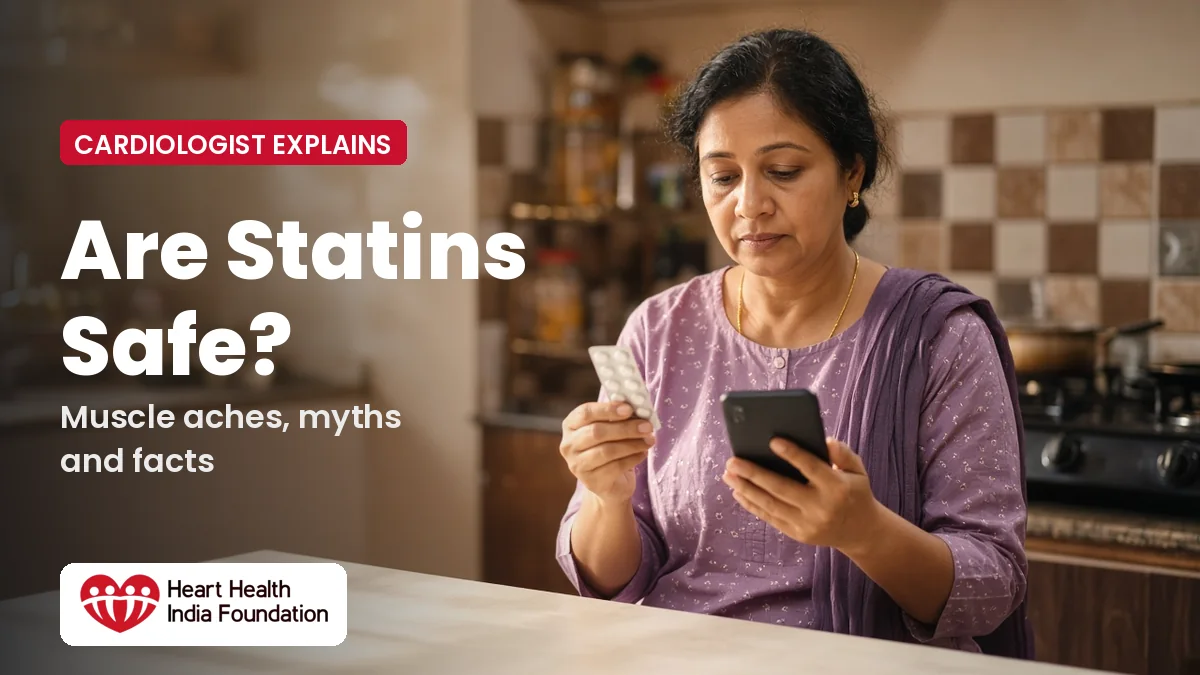
Short answer: Cardiologist Prof. Dr. Vijay Bang described statins as a very safe drug. He said the medical literature describes some problem in about 8–9% of patients, but in his own practice only about 2–3% have genuine muscle pain (myalgia), which has to be proven by blood tests. Much of the rest, he said, is fear after reading about statins online. Statins work in the liver to cut cholesterol production and can make risky plaque more stable.
“My legs ache since I started the cholesterol tablet. I read online that statins damage muscles. Should I be worried?”
Statins are a common cholesterol medicine for heart patients, and many patients fear them. Many patients hear about side effects from relatives, WhatsApp forwards or search results before they hear from their doctor. For more on cholesterol, see cholesterol myths that hurt heart patients.
In our Dil Ke Doubts session on cholesterol, triglycerides and Lp(a), Heart Health India Foundation founder Ram Khandelwal, who had his own heart attack at 33, asked about statins of cardiologist Prof. Dr. Vijay Bang, Past President, Cardiological Society of India; Senior Interventional Cardiologist, Lilavati Hospital, Mumbai.
This article is based on the questions and answers in Dil Ke Doubts Webinar 04 (10 Sep 2026), part of Heart Health India Foundation’s World Heart Month 2026 series with the Cardiological Society of India and the World Heart Federation‘s Don’t Miss a Beat campaign.
Here’s what he told us, in plain words.
How does a statin work?
Prof. Dr. Bang explained that the body’s cholesterol activity happens mainly in the liver. There, an enzyme called HMG-CoA reductase helps make cholesterol. A statin blocks this enzyme, which breaks the cycle of cholesterol manufacturing.
What does a statin do to plaque in the arteries?
He said that by working this way, a statin can:
- turn a “hot” (unstable) plaque into a more stable plaque
- shrink the plaque and reduce the overall plaque burden, though it does not make the plaque disappear completely
- help reduce repeat (secondary) and sudden (acute) heart events
For more on what your cholesterol numbers mean, read understanding LDL, Lp(a) and triglycerides.
What is a “hot” plaque, and why does it matter?
When Ram asked whether a statin does anything to soft plaque, Prof. Dr. Bang said: “Yes, of course, it stabilises the soft plaque.” He explained that a hot plaque is the kind that can cause a heart attack. With a statin, the plaque becomes stiffer and is no longer “hot”. A stable plaque is linked with stable heart disease, which can still cause angina (chest pain) if it is significant.
He mentioned that certain investigations, including a PET scan, can show whether a plaque is hot. Whether you need any such test is for your cardiologist to decide.
Are statins safe? What about muscle aches?
Prof. Dr. Bang called statins a very safe drug. On side effects, he said:
- the medical literature describes some issue in about 8–9% of patients
- in his own practice, he sees genuine muscle pain (myalgia) in only about 2–3% of patients
- statin myalgia has to be proven by blood tests before it is accepted as caused by the statin
- most of the time, he said, the pain is fear: patients read about it online, and the mind goes that way (he called it psychosomatic)
His message to patients was not to learn medicine from Google, because half-knowledge can mislead you and cause unnecessary mental stress.
What should patients ask their doctor?
- If you have chest pain, breathlessness or sweating, don’t wait. Call 112 or go to the nearest hospital.
- If you get muscle aches on a statin, tell your doctor rather than stopping the tablet on your own. Ask whether a blood test is needed to check if the statin is the cause.
- Don’t stop or change any heart medicine without talking to your doctor. Our guide understanding your heart medicines explains why each one matters.
- Bring your questions, not search results. Write down what worries you and ask at your next visit.
- Explore more sessions on our Dil Ke Doubts World Heart Month 2026 page.
Frequently asked questions
Prof. Dr. Vijay Bang explained that a statin blocks an enzyme in the liver called HMG-CoA reductase, which helps make cholesterol. This breaks the cycle of cholesterol manufacturing.
He said a statin can shrink plaque and reduce plaque burden, but it does not make plaque disappear completely. It can also make a hot, unstable plaque more stable.
In the session, he described a hot plaque as the kind that can cause a heart attack. A statin can stabilise it so it is no longer hot.
He said the literature describes some issue in about 8–9% of patients, but in his practice only about 2–3% have genuine muscle pain, proven by blood tests.
Not always. Prof. Dr. Bang said statin myalgia must be proven by blood tests, and much reported pain is fear after reading online. Tell your doctor about any aches instead of stopping the tablet yourself.
Watch the full session
Want to hear it from Prof. Dr. Bang himself? The full Dil Ke Doubts session is below. His answers on how statins work and on their safety start at about 23:50.
▶️ Watch the full session: Cholesterol, Triglycerides and Lp(a) · Please also Subscribe on YouTube @hearthealthindia.
In Prof. Dr. Bang’s words: “It doesn’t let the plaque size disappear… but it shrinks the plaque size. It reduces the plaque burden.”
Authoritative sources (for further reading)
These links support general education about statins. They do not replace Prof. Dr. Bang’s words in the session above, and they are not personal medical advice.
About this article
Disclaimer: The medical information in this article is based only on the views shared by the session speaker, Prof. Dr. Vijay Bang. It is for educational purposes only and is not medical advice. Please consult your cardiologist for advice personalised to you. In an emergency, go to the nearest hospital immediately. See also our medical disclaimer.
This is not medical advice. In an emergency, call 112 or go to the nearest hospital.
You don’t have to figure this out alone
Heart Health India is a community of patients, families and caregivers learning together, with India’s cardiologists, how to look after our hearts. If you have questions or worries about your cholesterol tablets, come ask them, share what you’re going through, and hear from people who’ve been there.