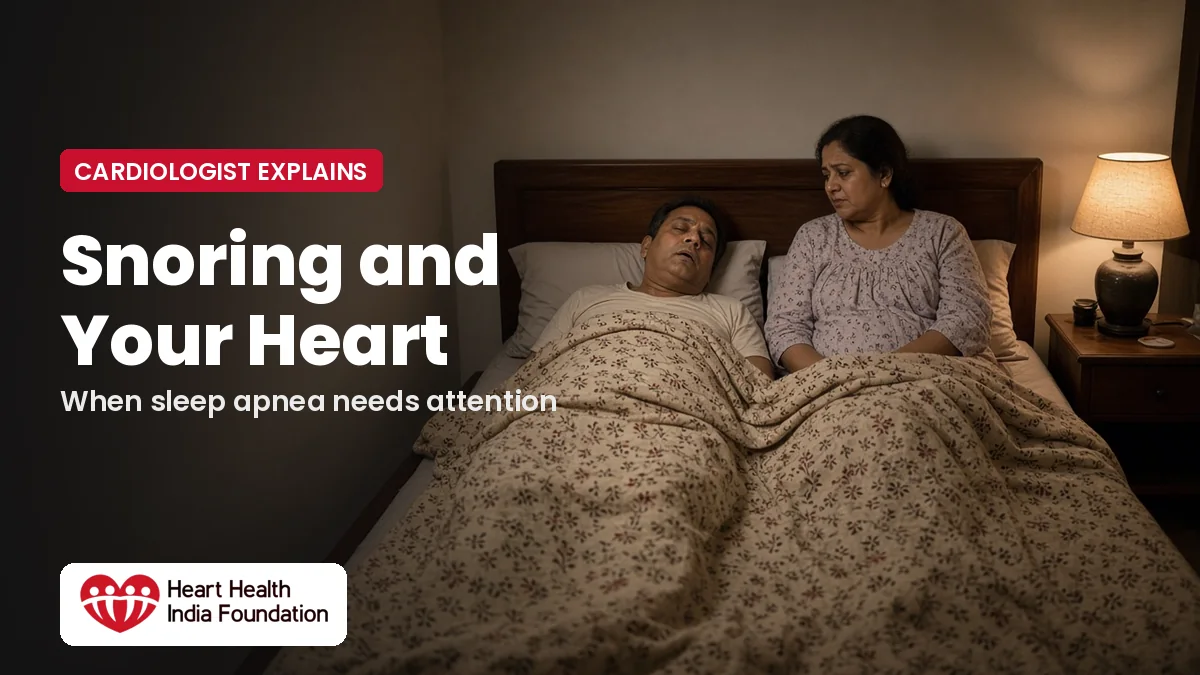
Short answer: Loud, habitual snoring can be a warning sign of obstructive sleep apnea (OSA), but snoring alone doesn’t prove it. Cardiologist Dr. M. Nandakumaran explained that in OSA the throat muscles relax and block the airway during sleep, oxygen levels dip, and heart rate and blood pressure change. OSA is common in people with heart conditions, and studies have found it in up to about half1 of people with high blood pressure.
“Is loud snoring just annoying, or could it be hurting my heart?”
In many Indian homes, snoring is a family joke. The person who snores often has no idea, and the person sleeping next to them just learns to live with it. But some snoring is a sign of something that matters for the heart.
In our Dil Ke Doubts session on stress, sleep and the heart, Heart Health India Foundation founder Ram Khandelwal, who had his own heart attack at 33, put this to cardiologist Dr. M. Nandakumaran, Professor of Cardiology at Madras Medical College and General Secretary of the CSI Chennai Chapter.
This article is based on the questions and answers in Dil Ke Doubts Webinar 08 (14 Sep 2026), part of Heart Health India Foundation’s World Heart Month 2026 series with the Cardiological Society of India and the World Heart Federation‘s Don’t Miss a Beat campaign.
Here’s what he told us, in plain words.
What is obstructive sleep apnea?
Dr. Nandakumaran asked us to imagine someone sleeping peacefully and breathing normally. Then the muscles of the throat relax enough to narrow, or briefly block, the upper airway. Breathing becomes very shallow or stops for a short time.
The brain senses this and briefly wakes the body so that breathing can restart. These brief arousals can happen again and again through the night, often without the person knowing. So someone may spend seven or eight hours in bed and still not get good sleep, only fragmented sleep.
What happens to the body during these episodes?
He said each episode can cause:
- a temporary drop in blood oxygen
- changes in heart rate and blood pressure
- activation of the body’s stress response (the sympathetic system), which can raise the heart rate and blood pressure
How much these changes matter varies from person to person, and depends partly on how severe the sleep apnea is.
Is loud snoring a sign of sleep apnea?
It can be. Dr. Nandakumaran called loud, habitual snoring the most familiar warning sign, but he was clear that snoring alone does not prove sleep apnea, and some people with OSA don’t snore noticeably. Other signs that can suggest OSA:
- someone noticing that you stop breathing during sleep
- gasping or choking during sleep
- waking often, or restless sleep
- a morning headache, or a dry mouth
- feeling very sleepy or tired during the day
- difficulty focusing or concentrating
- falling asleep without meaning to, especially when sitting quietly, or dangerously, while driving
Often, he said, the person sleeping beside the patient notices it first, even before the patient is aware.
Who is more likely to get sleep apnea?
He named obesity, increasing age and male sex as recognised risk factors, but stressed that OSA can occur at any body size, in either sex and at any age, including in people who aren’t overweight. Other contributors he mentioned: problems in the nose, mouth or jaw, and the use of alcohol, sedatives or some other medicines.
Why should a cardiologist worry about your sleep?
Because, in his words, sleep apnea is not simply a problem of snoring or poor sleep. OSA is common among people with heart and blood vessel conditions. He said studies have found an association between OSA and:
- high blood pressure
- atrial fibrillation, the most common abnormal heart rhythm (read more on palpitations and atrial fibrillation)
- heart failure
- coronary artery disease
- pulmonary hypertension (high blood pressure in the blood vessels of the lungs, which strains the right side of the heart)
- stroke
He added an important caution: these conditions share risk factors with OSA, so finding OSA does not by itself mean it caused the heart condition. Association is not always causation.
How is sleep apnea linked to high blood pressure?
Dr. Nandakumaran said OSA is frequently found in people with hypertension. Studies, he said, have found that about 50% of people with high blood pressure may have OSA, and it is even more common in resistant hypertension (BP that stays hard to control despite medicines), where almost 80% may be associated with OSA. More on BP in high blood pressure: the silent killer you can control.
What you can do next
- Chest pain or pressure, severe breathlessness, fainting or heavy sweating? Don’t wait. Call 112 or 108, or go to the nearest hospital emergency right away.
- Sudden weakness or numbness on one side of the body, a drooping face or slurred speech can be a stroke. Call 112 or 108 right away.
- If your partner says you stop breathing, gasp or choke at night, take it seriously and tell your doctor. Bring your partner along if you can, since they may have noticed more.
- If you feel sleepy while driving, mention it to your doctor and don’t brush it off. Until then, don’t drive when you feel drowsy.
- If you have high BP or a heart condition and also snore loudly, ask your doctor whether sleep apnea is worth discussing.
- For related reading, see our earlier guide Sleep and your heart: the overlooked connection, and why sleep plays a crucial role in heart function. Explore more sessions on our Dil Ke Doubts World Heart Month 2026 page.
Frequently asked questions
Dr. M. Nandakumaran explained that the throat muscles relax during sleep and narrow or block the upper airway, so breathing becomes shallow or stops briefly. The brain briefly wakes the body to restart breathing, which fragments sleep.
Not necessarily. He called loud, habitual snoring the most familiar warning sign, but said snoring alone does not prove sleep apnea, and some people with OSA don’t snore noticeably.
Someone noticing you stop breathing in sleep, gasping or choking, restless sleep, a morning headache, dry mouth, daytime sleepiness, poor concentration, and falling asleep unintentionally, including while driving.
Yes. Obesity, older age and male sex are recognised risk factors, but Dr. Nandakumaran said OSA can occur at any body size, in either sex and at any age.
He said studies have found an association between OSA and high BP, atrial fibrillation, heart failure, coronary disease, pulmonary hypertension and stroke, with OSA in about 50% of people with high BP and up to 80% with resistant hypertension.
Watch the full session
Want to hear it from Dr. Nandakumaran himself? The full Dil Ke Doubts session is below. His talk on sleep apnea starts at about 04:25.
▶️ Watch the full session: Stress, Sleep, Mental Health and Environmental Risk · Please also Subscribe on YouTube @hearthealthindia.
In Dr. Nandakumaran’s words: “Sleep apnea is not simply a problem of snoring or poor sleep. OSA is common among people with cardiovascular disorders.”
Authoritative sources (for further reading)
These links support general education about sleep apnea. They do not replace Dr. Nandakumaran’s words in the session above, and they are not a personal diagnosis.
- NHLBI (NIH) — Sleep apnea
- MedlinePlus — Sleep apnea
- NHS — Obstructive sleep apnoea
- Cardiological Society of India
Sources and what they mean
- According to the American Heart Association’s 2021 scientific statement on sleep apnea and heart disease, this means sleep apnea is found in about 30 to 50 out of every 100 people with high blood pressure, so up to about half of them may have it. American Heart Association: Sleep apnea worsens heart disease, yet often untreated (2021)
About this article
Disclaimer: The medical information in this article is based only on the views shared by the session speaker, Dr. M. Nandakumaran. It is for educational purposes only and is not medical advice. Please consult your cardiologist for advice personalised to you. Chest pain or pressure, severe breathlessness, fainting or heavy sweating? Don’t wait. Call 112 or 108, or go to the nearest hospital emergency right away. See also our medical disclaimer.
This is not medical advice. Chest pain or pressure, severe breathlessness, fainting or heavy sweating? Don’t wait. Call 112 or 108, or go to the nearest hospital emergency right away.
You don’t have to figure this out alone
Heart Health India is a community of patients, families and caregivers learning together, with India’s cardiologists, how to look after our hearts. If snoring, poor sleep or a heart condition has left you with questions, come ask them, share what you’re going through, and hear from people who’ve been there.