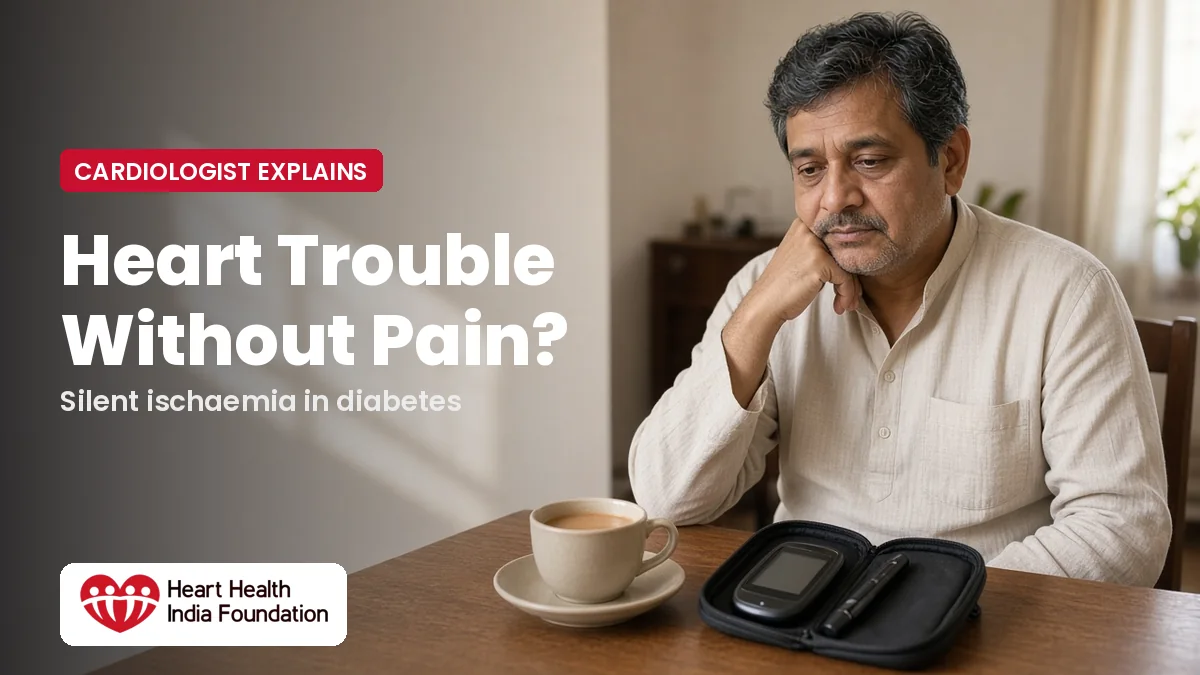
Short answer: Some people with diabetes may not feel the usual chest pain when the heart is short of blood. Cardiologist Dr. Kamal Harishchandra Sharma said diabetes can weaken the nerves that carry the feeling of pain, and that in about 20–30% of people with diabetes this pain may not be felt. Diabetes can also harm the heart in ways other than blockages, so he listed warning signals not to neglect. For the wider picture, see our broader guide to diabetes and heart disease.
“I have diabetes, but I feel fine. If there’s no chest pain, how would I know my heart is in trouble?”
Most of us picture a heart problem as chest pain. That is the warning sign we wait for. In diabetes, doctors often use a term that worries families: silent ischaemia (also spelt silent ischemia), where the heart may not be getting enough blood but the person doesn’t feel the typical pain.
In our Dil Ke Doubts session on diabetes and the heart, Heart Health India Foundation founder Ram Khandelwal, who had his own heart attack at 33, asked exactly this of cardiologist Dr. Kamal Harishchandra Sharma, Associate Professor in Cardiology at the U. N. Mehta Institute of Cardiology & Research Centre, Ahmedabad.
This article is based on the questions and answers in Dil Ke Doubts Webinar 03 (9 Sep 2026), part of Heart Health India Foundation’s World Heart Month 2026 series with the Cardiological Society of India and the World Heart Federation‘s Don’t Miss a Beat campaign.
The session was in Hindi. Here’s what he told us, in plain words.
What is classic angina, and why does it hurt?
Dr. Sharma explained that when the heart’s arteries narrow, less blood reaches the heart muscle. The usual signal of this is angina, which means chest pain. That pain is how many patients come to know that their heart isn’t getting enough blood. Our guide to recognising heart attack warning signs covers the familiar signs.
Why may people with diabetes not feel heart pain?
He started with an example many families will know. When a person with diabetes develops gangrene in the foot, he said, they often don’t feel the pain, because diabetes dries up (damages) the nerves that carry sensation.
The same can happen with the heart. In the session he said that in about 20 to 30% of people with diabetes, this pain may not be felt, because the nerves become so weak that they can’t pass on the feeling of pain. This is what is meant by silent ischaemia: less blood reaching the heart muscle without the usual chest pain being felt.
He also called diabetes “a silent killer”: it doesn’t harm through diabetes alone, but through other diseases, and heart disease is one of them. On why “I feel fine” can be risky, read why “I don’t feel any symptoms” can become dangerous.
Is it only about blocked arteries?
No, and Dr. Sharma called this one of the biggest misunderstandings. Diabetes doesn’t trouble the heart only by blocking its arteries and causing a heart attack. He said it can also cause:
- Diabetic cardiomyopathy: weakness of the heart muscle
- Irregular heartbeat: problems with the heart’s rhythm (read more on palpitations and atrial fibrillation)
- Weak pumping: the heart not pumping as strongly as it should (see living with heart failure)
Which warning signals should you not ignore?
Because chest pain may not always come, Dr. Sharma listed signals that a person with diabetes should not neglect:
- An irregular heartbeat
- Blood pressure going up and down (more on high blood pressure)
- Breathlessness
- Feeling restless or uneasy
- Blood sugar going up and down
What should you do next?
- Chest pain or pressure, severe breathlessness, fainting or heavy sweating? Don’t wait. Call 112 or 108, or go to the nearest hospital emergency right away.
- If you have diabetes, tell your doctor about any of these signals, even if you have no chest pain. Describe them in your own words.
- If you look after a parent with diabetes, keep this list handy and mention anything you notice at their next appointment. If any of these signs comes on suddenly or feels severe, don’t wait for the appointment: follow the emergency step above.
- Explore more sessions on our Dil Ke Doubts World Heart Month 2026 page.
Frequently asked questions
It means less blood reaching the heart muscle without the usual chest pain being felt. In the session, Dr. Kamal Harishchandra Sharma explained that diabetes can weaken the nerves that carry pain, so the warning may not come.
Dr. Sharma said diabetes can damage the nerves that carry the feeling of pain, much as a person with diabetes may not feel pain from gangrene in the foot.
In the session, Dr. Sharma said about 20 to 30% of people with diabetes may not feel this pain.
Yes. He said diabetes can also cause diabetic cardiomyopathy (weak heart muscle), an irregular heartbeat and weak pumping, not only blocked arteries.
Dr. Sharma listed signals not to neglect: an irregular heartbeat, blood pressure going up and down, breathlessness, restlessness, and blood sugar going up and down. Tell your doctor about them.
Watch the full session
Want to hear it from Dr. Sharma himself? The full Dil Ke Doubts session is below (in Hindi). His answer on silent ischaemia starts at about 07:20.
▶️ Watch the full session: Diabetes and the Heart · Please also Subscribe on YouTube @hearthealthindia.
In Dr. Sharma’s words (translated from Hindi): “Diabetes doesn’t cause heart trouble only through blockages and heart attacks. Apart from that, it can cause many other problems.”
Authoritative sources (for further reading)
These links support general education about diabetes and the heart. They do not replace Dr. Sharma’s words in the session above, and they are not a personal diagnosis.
- MedlinePlus — Diabetic heart disease
- NIDDK (NIH) — Diabetes, heart disease and stroke
- NHS — Angina
- Cardiological Society of India
About this article
Disclaimer: The medical information in this article is based only on the views shared by the session speaker, Dr. Kamal Harishchandra Sharma. It is for educational purposes only and is not medical advice. Please consult your cardiologist for advice personalised to you. Chest pain or pressure, severe breathlessness, fainting or heavy sweating? Don’t wait. Call 112 or 108, or go to the nearest hospital emergency right away. See also our medical disclaimer.
This is not medical advice. Chest pain or pressure, severe breathlessness, fainting or heavy sweating? Don’t wait. Call 112 or 108, or go to the nearest hospital emergency right away.
You don’t have to figure this out alone
Heart Health India is a community of patients, families and caregivers learning together, with India’s cardiologists, how to look after our hearts. If you or someone you love lives with diabetes and has questions about the heart, come ask them, share what you’re going through, and hear from people who’ve been there.