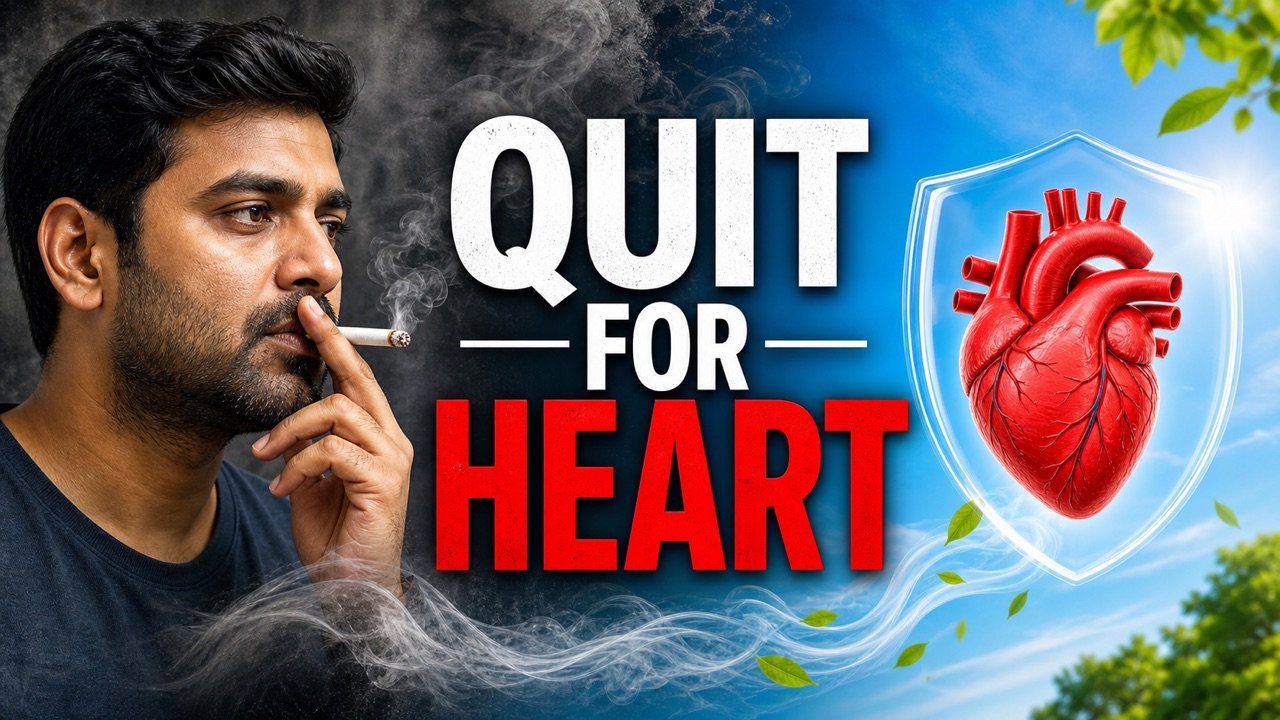
In short: Smoking and heart disease are tightly linked: tobacco damages the artery lining, raises blood pressure, lowers protective HDL cholesterol and makes blood more likely to clot — driving heart attacks and strokes. There is no safe form or “safe amount.” The encouraging part: the heart starts repairing within hours of your last cigarette, and quitting helps at any age and any stage.
Key takeaways
- Tobacco harms the heart in every form — cigarettes, bidis, hookah, gutka, khaini and vapes.
- There is no safe level of tobacco for the heart; even light or occasional smoking raises risk.
- Quitting works fast — blood pressure and oxygen levels begin improving within a day.
- Quitting helps even after a heart attack, significantly improving survival.
- Secondhand smoke harms your family’s hearts too; a smoke-free home protects everyone.
Most people associate smoking with lung cancer, but the heart is often the first and most lethal casualty of tobacco. Smoking is one of the most powerful and most preventable causes of heart disease, and in India — where tobacco is consumed not only as cigarettes but as bidis, hookah, gutka and other smokeless forms — the danger is widespread and frequently underestimated. If you or someone you love uses tobacco, understanding the link between smoking and your heart could be the single most important thing you read this year.
How smoking damages the heart and arteries
Every cigarette sets off a cascade of harm inside your blood vessels. The chemicals in tobacco smoke injure the delicate inner lining of the arteries, making it easier for fatty plaque to build up — a process called atherosclerosis that narrows and stiffens the vessels that feed the heart. Nicotine raises your heart rate and blood pressure, forcing the heart to work harder. Carbon monoxide from smoke displaces oxygen in the blood, so the heart receives less of the oxygen it desperately needs. Smoking also makes the blood “stickier” and more likely to clot, and it lowers protective HDL cholesterol.
The combined effect is dramatic: smokers have a substantially higher risk of heart attack, stroke, dangerous rhythm disturbances and peripheral artery disease. For people who already have heart disease, continuing to smoke sharply increases the chance of another event. Tobacco does not give the heart a single big blow; it delivers thousands of small ones, day after day.
“But I only smoke a little” — and other myths
Many patients believe that light or occasional smoking is relatively safe. It is not. Even a few cigarettes a day meaningfully raises cardiovascular risk, and there is no safe level of tobacco exposure for the heart. Hookah is often seen as a milder, social alternative, yet a single session can deliver large amounts of smoke and toxins. Bidis, though smaller, are not gentler — they often require harder puffing and deliver high levels of harmful compounds. Smokeless tobacco such as gutka and khaini avoids smoke but still raises blood pressure and cardiovascular risk.
Secondhand smoke matters too. Family members — including children and elders — who breathe a smoker’s smoke face raised heart and vascular risk themselves. Quitting protects not only you but everyone in your home.
The good news: quitting works, fast
Here is the most encouraging fact about smoking and your heart: the body begins to repair itself almost immediately after you stop. Within a day, blood pressure and the oxygen-carrying capacity of the blood start to improve. Over weeks and months, circulation and lung function get better. Over a year, the excess risk of heart disease falls substantially, and over several years it continues to decline toward that of a non-smoker. Quitting helps at any age and at any stage — even patients who stop after a heart attack significantly improve their survival. It is never “too late” for your heart to benefit.
A practical plan to quit
Quitting is hard because nicotine is genuinely addictive, but a structured approach greatly improves your odds. Set a clear quit date and tell your family so they can support you. Identify your triggers — the chai-and-cigarette habit, after meals, stress, social settings — and plan specific alternatives such as a short walk, a glass of water, deep breathing or chewing saunf. Remove cigarettes, lighters and ashtrays from your environment.
Speak to your doctor about proven aids: nicotine replacement therapy (patches, gum, lozenges) and certain prescription medicines can roughly double your chances of success, and counselling or quit-lines add further benefit. Expect cravings to come in waves that pass within a few minutes — ride them out rather than fighting them forever. If you slip, treat it as a stumble, not a failure, and continue. Each attempt teaches you something that makes the next more likely to stick.
What happens to your heart, week by week, after you quit
It can be powerfully motivating to know the timeline of recovery. Within about twenty minutes of your last cigarette, heart rate and blood pressure begin to settle. Within a day, the level of carbon monoxide in your blood drops and oxygen delivery improves. Within a few weeks to months, circulation and lung function get noticeably better, making physical activity easier. Over the course of a year, the excess risk of coronary heart disease falls substantially compared with someone who continues to smoke, and over the following years it keeps declining toward — though for heavy long-term smokers not always fully reaching — that of a never-smoker. The body is remarkably forgiving; from the moment you stop, it begins repairing the damage. This is why quitting is worthwhile at any age and at any stage of heart disease.
Helping a loved one quit
Family members often feel helpless watching someone they love continue to smoke, and the wrong approach — nagging, shaming or ultimatums — frequently backfires. What helps is steady, non-judgmental support. Encourage without lecturing, celebrate small milestones, and be patient with slip-ups, which are a normal part of quitting rather than proof of failure. Make the home smoke-free, which protects everyone and removes triggers. Offer to be a “quit buddy,” to handle stressful tasks during the hardest early days, or simply to be a distraction when cravings strike. If your loved one already has heart disease, gently connecting their smoking to their heart — and to their desire to be there for the family — can be more motivating than fear alone.
Tobacco in all its forms
In India, tobacco wears many disguises, and quitting means addressing all of them. Cigarettes, bidis and hookah deliver smoke directly to the lungs and bloodstream. Smokeless products — gutka, khaini, zarda, paan masala with tobacco and similar — are extremely common and often wrongly seen as harmless, yet they raise blood pressure and cardiovascular risk and carry their own serious dangers. E-cigarettes and vaping, sometimes marketed as “safe,” still deliver nicotine and are not a risk-free choice for the heart. The bottom line is consistent across every form: there is no safe level of tobacco for your cardiovascular system, and giving up any and all forms is one of the most powerful gifts you can give your heart.
Frequently Asked Questions
How quickly does quitting smoking help the heart? Almost immediately. Within 24 hours, blood pressure and blood oxygen begin to improve, and over the following months and years the risk of heart attack and stroke falls steadily.
Is hookah safer for the heart than cigarettes? No. A hookah session can expose you to large volumes of smoke and toxins and carries real cardiovascular risk. It is not a safe alternative to cigarettes.
Does smokeless tobacco like gutka affect the heart? Yes. Smokeless tobacco still delivers nicotine, raises blood pressure and increases cardiovascular risk, even though it does not produce smoke.
I already have heart disease — is there any point in quitting now? Absolutely. Quitting after a diagnosis or even after a heart attack significantly lowers the risk of further events and improves survival. The benefit is large and worthwhile at any stage.
Can nicotine replacement therapy be used safely by heart patients? For most patients, supervised nicotine replacement is far safer than continuing to smoke. Discuss the best option for your situation with your doctor.
Handling weight gain and cravings after quitting
A worry that keeps many people smoking is the fear of gaining weight after quitting. Some weight gain is common, partly because nicotine suppresses appetite and slightly raises metabolism, and partly because food simply tastes better once the senses recover. But it is important to keep this in perspective: any modest weight gain is vastly outweighed by the enormous heart and health benefits of stopping tobacco, and it can be managed. Plan ahead by keeping healthy snacks like fruit, roasted chana or nuts on hand for cravings, staying physically active, and drinking water when the urge to nibble strikes.
Cravings themselves are temporary, usually peaking in the first days and weeks and fading over time. When a craving hits, remember it typically passes within a few minutes whether or not you smoke — so delay, distract and breathe through it. Keep your hands and mouth busy, step outside for a short walk, or sip water or tea. Identify and plan for your personal trigger moments, such as after meals or with chai, and substitute a new ritual. With time, these triggers lose their grip, and the new tobacco-free routines become second nature. Each craving you ride out is a small victory that strengthens your freedom from tobacco.
Will I gain weight if I quit smoking? Some modest weight gain is common after quitting, but it is easily outweighed by the heart and health benefits of stopping. It can be managed with healthy snacks, activity and water, and any small gain is far less harmful than continuing to smoke.
Is secondhand smoke really dangerous for my family? Yes. Breathing another person’s tobacco smoke raises heart and vascular risk for family members, including children and elders. Making your home smoke-free protects everyone, not just the smoker.
The bottom line for patients, families and people at risk
The link between smoking and your heart is one of the clearest and most actionable in all of medicine: tobacco harms the heart in every form, and quitting helps dramatically at any age and any stage. For people who use tobacco, this is genuine hope — your body begins repairing itself within hours of stopping, and the benefits grow with every smoke-free day. For families, your steady, non-judgmental support can be the deciding factor in a loved one’s quit attempt, and a smoke-free home protects everyone’s heart. And for people at risk, never starting, or stopping now, removes one of the single biggest threats to a long and healthy life. Quitting is hard, but it is achievable with the right plan, support and persistence — and few decisions you ever make will do more for your heart.
Join the HHIF Heart Health Community
Quitting tobacco is far easier with encouragement, accountability and people cheering you on. You don’t have to do it alone.
Heart disease is India’s number one killer, and tobacco is one of its biggest drivers — yet most people trying to quit get little ongoing support. Misinformation about “safe” tobacco is everywhere, and patients often feel isolated in their struggle. That’s why patient communities matter: they offer reliable answers, shared experience and steady motivation when willpower runs low.
The Heart Health India Foundation (HHIF) is India’s first patient-led heart health organisation. Our community brings together patients, caregivers, health professionals and health-conscious individuals, giving you real-time guidance from cardiologists and other experts, myth-busting content, habit-building challenges, webinars and resources, and the support of people who have quit and protected their hearts. Joining takes about two minutes, connects you to our WhatsApp and Facebook groups, and is 100% free, forever.
Join the HHIF Heart Health Community today »
Medical disclaimer
This article is for general education and awareness and is not a substitute for professional medical advice. Please consult a qualified doctor about your own heart health and before changing any medication. If you think you are having a heart attack, seek emergency care immediately.
Related reading from Heart Health India Foundation
- Understanding heart health: the basics
- Good fats vs bad fats, explained
- Simple ways to stay active during busy workdays
- How chronic stress impacts heart health
- “Was it really a heart attack?” — Rohan’s story