Guarding Little Hearts — Early Heart Health Awareness for Children

In short: Heart health starts in childhood. The early stages of artery narrowing, and risk factors like obesity, high blood pressure and unhealthy cholesterol, can begin young — and Indian children develop heart disease risk earlier than many populations. The most powerful protection is a home built around wholesome food, daily active play, limited screens, good sleep and no tobacco, plus awareness of a few warning signs and family-history clues. Key takeaways The earliest changes of heart disease can begin in childhood, shaped by daily habits. Two separate issues: inherited or structural heart conditions (uncommon) and lifestyle-related risk (widespread). A family history of sudden, unexplained young death should always be mentioned to a doctor. Children learn by imitation — model the food and activity you want. Watch for fainting or chest pain during exercise, unusual breathlessness, or a racing heartbeat. We tend to think of heart disease as a problem of middle and old age, but the foundations of a healthy — or unhealthy — heart are laid much earlier, often in childhood. The eating habits, activity levels and body weight a child develops can echo across an entire lifetime. With childhood obesity, screen time and processed food on the rise across India, protecting children’s heart health has never been more important. This guide is for parents, grandparents and caregivers who want to give the next generation the strongest possible cardiac start. Why heart health starts in childhood Atherosclerosis — the gradual build-up of fatty deposits in arteries that eventually causes heart attacks — can begin silently in childhood and adolescence. The habits formed in these years strongly shape adult risk. A child who grows up active, eating mostly wholesome home food and maintaining a healthy weight is far more likely to carry those protective patterns into adulthood. Conversely, childhood obesity, high blood pressure and unhealthy cholesterol are increasingly common and track forward into adult disease. Because Indians develop heart disease about a decade earlier than Western populations, building protective habits early is especially valuable here. Two kinds of heart concerns in children It helps to distinguish two separate issues. The first is congenital and structural heart conditions — heart problems a child is born with, or inherited heart muscle and rhythm disorders that can run in families. These are relatively uncommon but important, and a family history of sudden, unexplained death at a young age should always be mentioned to a doctor, as it can flag inherited conditions worth screening for. The second, and far more widespread, is lifestyle-related risk — the early seeding of obesity, high blood pressure, diabetes and unhealthy cholesterol through diet and inactivity. This is the area where families have the most day-to-day influence, and where small, consistent choices pay enormous long-term dividends. Building heart-healthy habits early Nutrition is the cornerstone. Favour home-cooked meals built around whole grains, dal, vegetables, fruit and dairy, and treat sugary drinks, packaged snacks, fried foods and fast food as occasional rather than everyday items. Children learn by imitation, so a household that eats well together raises children who eat well. Avoid using junk food as a reward, which teaches the brain to associate unhealthy food with comfort and celebration. Physical activity should be a natural, joyful part of childhood. Encourage outdoor play, sports, cycling and simply running around — children need substantial active time most days. Equally important is limiting recreational screen time, which displaces movement and is linked to weight gain and poorer health. Protect sleep, too, since poor sleep is associated with weight and metabolic problems even in the young. Avoiding tobacco exposure is vital. Children in smoking households breathe secondhand smoke that harms their developing hearts and vessels, and adolescents who start tobacco set themselves up for early cardiovascular damage. A smoke-free home is a gift to a child’s heart. Warning signs and when to seek help Most childhood heart symptoms are not dangerous, but some deserve prompt medical attention: fainting during exercise or exertion, chest pain with activity, unusual breathlessness or tiring far more easily than peers, a racing or irregular heartbeat, or bluish lips in a young child. A family history of inherited heart disease or sudden cardiac death in a young relative should prompt a conversation with a doctor about whether screening is appropriate. When in doubt, it is always reasonable to have a child evaluated. Making healthy choices the easy choices at home Children rarely respond to lectures about cholesterol or arteries, but they respond powerfully to environment and example. The most effective strategy is to make the healthy choice the easy, default choice at home. Stock the kitchen with fruit, nuts, roasted snacks, milk and wholesome options within easy reach, and keep sugary drinks, chips and biscuits out of the house rather than relying on willpower. Eat meals together as a family at the table, without screens, which improves both food choices and the parent–child bond. Cook with children sometimes, so they grow up understanding and valuing real food. Crucially, model the behaviour you want — children of active, healthy-eating parents tend to become active, healthy-eating adults. Avoid labelling children as “fat” or restricting food in shaming ways, which can damage self-esteem and relationship with food; instead, focus positively on health, energy and strength for play and sport. Screens, sleep and the modern childhood Two features of modern childhood deserve special attention because both quietly affect heart health. The first is screen time. Hours spent on phones, tablets, television and games displace active play, are often paired with snacking, and are linked to weight gain. Setting clear, consistent limits on recreational screen time — and keeping screens out of bedrooms and away from mealtimes — protects activity levels and sleep alike. The second is sleep itself. Children and teenagers need substantial, regular sleep, and chronic sleep deprivation is associated with weight gain, poorer food choices and metabolic problems even in the young. A predictable bedtime routine, a screen-free wind-down period, and a dark, quiet sleeping environment all help. Protecting movement
Is Sitting the New Smoking? How a Sedentary Lifestyle Hurts Your Heart
In short: Long, unbroken sitting is an independent risk factor for heart disease — it slows circulation and nudges blood pressure, blood sugar, cholesterol and belly fat in the wrong direction. Strikingly, a single daily workout may not fully undo the harm of sitting for the other 15 waking hours. The fix is to both exercise regularly and break up sitting with short, frequent movement. Key takeaways Prolonged sitting raises heart risk independently of how much you weigh. Physically inactive people have a 20–30% higher risk of death (WHO). One daily workout doesn’t fully cancel 15 hours of sitting — break up sitting too. Aim to stand or move every 30–60 minutes; “movement snacks” add up. Heart patients should follow movement guidance from their cardiologist or rehab team. Modern life has quietly engineered movement out of our days. We commute sitting down, work sitting down, eat sitting down and relax in front of screens — also sitting down. The phrase “sitting is the new smoking” has become popular precisely because long hours of inactivity carry a serious, often invisible toll on the heart. For India’s growing population of office workers, students and urban professionals, understanding how a sedentary lifestyle and heart disease are connected is increasingly urgent. What too much sitting does to your body When you sit for hours, your large leg muscles — normally busy helping circulate blood and burn fuel — go almost completely idle. Blood flow slows, the body becomes less efficient at clearing fats and sugar from the bloodstream, and over time this contributes to higher blood pressure, higher blood sugar, unhealthy cholesterol levels and weight gain around the abdomen. Each of these is an independent risk factor for heart disease, and prolonged sitting nudges all of them in the wrong direction at once. What makes inactivity especially insidious is that the damage accumulates silently. There is no immediate pain or obvious signal, so the habit feels harmless even as risk quietly climbs. Research has increasingly shown that long uninterrupted sitting is linked to higher cardiovascular risk — and, strikingly, that even people who exercise once a day may not fully undo the harm of sitting for the other fifteen waking hours. The pattern of movement across the whole day matters, not just a single workout. Why exercising once a day may not be enough It is tempting to think that a 30-minute morning walk buys you permission to sit for the rest of the day. Unfortunately, the body does not work on a simple credit system. Studies suggest that prolonged, unbroken sitting carries its own risk even among people who meet exercise guidelines. The goal, therefore, is twofold: get regular structured exercise and break up sitting time throughout the day. Think of it as “exercise plus movement” rather than “exercise instead of movement.” Simple ways to sit less and move more The good news is that fighting a sedentary lifestyle does not require a gym membership or dramatic life changes — it requires frequent, small interruptions to sitting. Set a gentle reminder to stand or walk for a few minutes every half hour to hour. Take phone calls standing or walking. Use the stairs instead of the lift for a floor or two. Park a little farther away, or get off the bus a stop early. Walk over to a colleague’s desk instead of messaging. After meals, take a short stroll rather than collapsing onto the sofa, which also helps blood sugar. At home, stand or do light stretches during television breaks, and involve the family in evening walks so movement becomes a shared habit rather than a chore. If your work is desk-bound, ask whether a standing desk or a “walking meeting” culture is possible. The principle is simple: motion is lotion for the cardiovascular system, and frequent small movements add up to meaningful protection. Building an active day that protects your heart A heart-healthy day combines three layers. First, reduce total sitting time wherever you reasonably can. Second, break up the sitting you cannot avoid with brief movement every half hour or so. Third, include dedicated activity most days — a brisk walk, cycling, swimming, yoga or any movement you enjoy and will sustain. Consistency beats intensity, and the best activity is the one you will actually keep doing. For people who already have heart disease, the same principles apply, but the intensity should be guided by your cardiologist or cardiac rehabilitation team. The hidden ways sitting harms more than the heart Prolonged sitting does not only affect the cardiovascular system; its effects ripple through the whole body, and many of those effects loop back to harm the heart. Long hours of inactivity are linked to higher rates of type 2 diabetes, partly because idle muscles become less sensitive to insulin, and diabetes is itself a powerful heart-disease driver. Sitting for long periods can also contribute to poor posture, back and neck pain, and reduced muscle and bone strength over time, making people even less inclined to move — a vicious cycle. There is also a circulation concern: sitting still for very long stretches, such as on long flights or journeys, can raise the risk of blood clots forming in the legs. And inactivity is associated with lower mood and higher stress, both of which independently affect heart health. Seen this way, breaking up sitting is not a minor tweak but a broad investment in overall health. Designing a heart-friendly workspace and home Small environmental changes make movement the default rather than an effort of willpower. At work, position your printer, dustbin or water source a little farther away so you naturally walk to them. Keep a water bottle that needs refilling, prompting regular trips. Stand during phone calls and suggest occasional “walking meetings” for one-to-one discussions. If a sit-stand desk is available, alternate between sitting and standing through the day. At home, avoid marathon television or screen sessions by standing or stretching during breaks, doing light chores between episodes, or
Diabetes and Heart Disease: The Link Indians Can’t Ignore
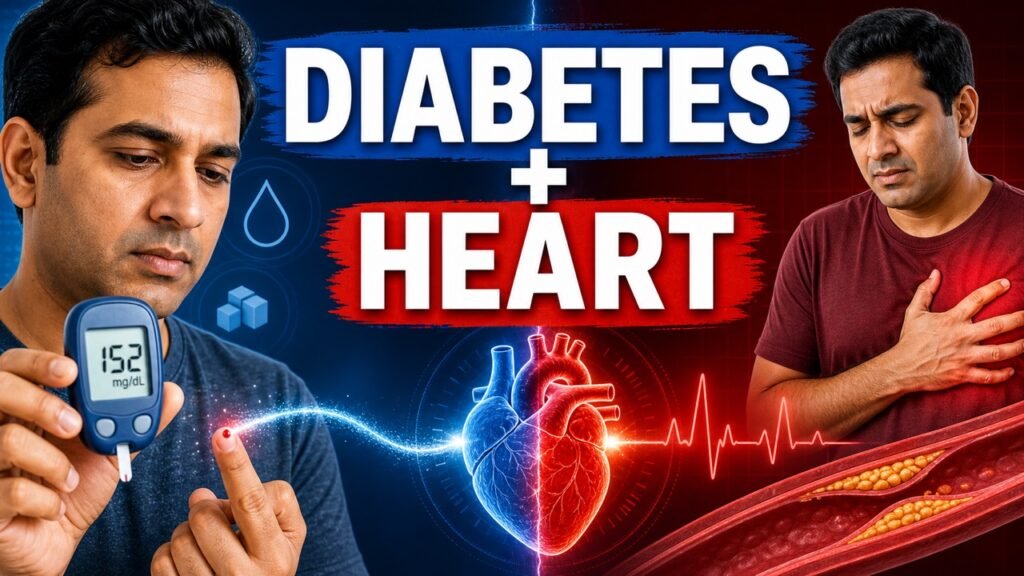
In short: Diabetes and heart disease are deeply linked. Persistently high blood sugar damages the arteries that feed the heart and usually travels with high blood pressure and abnormal cholesterol, multiplying risk. In India this strikes a decade earlier than in Western populations. Diabetes can also cause “silent” heart attacks with little chest pain — so screening and protecting blood pressure, cholesterol and weight matter as much as blood sugar. Key takeaways Diabetes is treated by doctors as a high cardiovascular-risk condition, even before symptoms. High blood glucose causes roughly 11% of cardiovascular deaths worldwide (WHO). Diabetic nerve damage can cause “silent” heart attacks with no classic chest pain. Protect the heart by managing blood sugar, blood pressure, cholesterol, weight and tobacco together. Indians develop diabetes younger and at lower body weight — so screen earlier. India is often described as the diabetes capital of the world, and that statistic carries a hidden, heavier tragedy: diabetes is also one of the most powerful drivers of heart disease. Many people manage their blood sugar carefully yet never realise that the bigger threat to their lives is what diabetes is quietly doing to their heart and arteries. Understanding the link between diabetes and heart disease — and acting on it early — can add years of healthy life. Why diabetes is so hard on the heart Persistently high blood sugar damages blood vessels throughout the body, including the coronary arteries that supply the heart. Over time this accelerates atherosclerosis, the build-up of fatty plaque that narrows arteries and sets the stage for heart attacks and strokes. Diabetes rarely travels alone, either — it often comes bundled with high blood pressure, abnormal cholesterol (high triglycerides and low HDL), and excess abdominal fat, a combination sometimes called metabolic syndrome. Each of these is a heart risk factor in its own right, and together they multiply the danger. People with diabetes are considerably more likely to develop coronary artery disease and to develop it earlier. They are also prone to a specific weakening of the heart muscle and to heart failure. This is why doctors often treat a person with diabetes as already being in a high cardiovascular risk category, even before any heart symptoms appear. The “silent” danger: heart attacks without typical pain One of the most frightening aspects of diabetic heart disease is that nerve damage from long-standing diabetes can blunt the sensation of pain. As a result, a person with diabetes may have a heart attack with little or no classic chest pain — a so-called “silent” heart attack. They might instead feel only unusual fatigue, breathlessness, indigestion, sweating or a vague sense of being unwell. Because the warning is muted, the danger is greater. This makes regular heart screening and attention to subtle symptoms especially important for anyone living with diabetes. How to protect your heart when you have diabetes The encouraging news is that the same actions that control diabetes also protect the heart, and modern care can dramatically reduce risk. Keeping blood sugar within your target range is the foundation, but it is only part of the picture. Equally important is controlling blood pressure and cholesterol. Many people with diabetes benefit from cholesterol-lowering treatment to reach lower LDL targets, because Indians develop heart disease about a decade earlier than Western populations and the high-risk thresholds are stricter. Newer classes of diabetes medicines have been shown not only to lower blood sugar but also to protect the heart and kidneys — ask your doctor whether these are appropriate for you. Lifestyle remains powerful. A diet rich in whole grains, legumes, vegetables and healthy fats, with limited sugar, refined carbohydrates, fried foods and salt, helps blood sugar, weight and the heart simultaneously. Regular physical activity improves insulin sensitivity and cardiovascular fitness. Stopping tobacco is non-negotiable, because smoking and diabetes together are an especially deadly combination. And regular check-ups — including blood pressure, lipids, kidney function and an assessment of heart risk — let problems be caught and treated early. Why Indians with diabetes face higher heart risk There are specific reasons the diabetes–heart connection is so dangerous in the Indian context. South Asians tend to develop type 2 diabetes at a younger age and at a lower body weight than many other populations, often carrying excess fat around the abdomen even when overall weight looks normal — the so-called “thin-fat” pattern. This abdominal fat is metabolically active and drives insulin resistance, inflammation and harmful changes in cholesterol. Indians also frequently have a particular lipid pattern with high triglycerides and low protective HDL cholesterol, which is especially atherogenic. Combine this with high rates of high blood pressure, a strong genetic predisposition, and lifestyle shifts toward refined carbohydrates, sugar and inactivity, and you have a population in which diabetes translates into heart disease unusually early and aggressively. Understanding this is not cause for despair but for vigilance: it means screening and risk-factor control should begin earlier and be pursued more determinedly. The other organs diabetes affects — and why it’s connected Diabetes does not damage the heart in isolation; it harms the entire vascular system, and these effects are interlinked. The same processes that injure the coronary arteries also damage the arteries to the brain (raising stroke risk), the kidneys (diabetic kidney disease, which in turn worsens blood pressure and heart risk), the eyes and the nerves and blood vessels of the legs and feet. Kidney disease and heart disease in particular feed on each other, which is why doctors increasingly think in terms of protecting the heart and kidneys together. The encouraging flip side is that the steps that protect your heart — controlling sugar, blood pressure and cholesterol, staying active, eating well and not smoking — protect all of these organs simultaneously. One coherent set of healthy habits defends your whole body. Building a daily routine that protects your heart Translating knowledge into daily life is what matters. Aim for a consistent routine: regular meals built around vegetables, dal, whole
Smoking and Your Heart: What Every Patient Should Know
In short: Smoking and heart disease are tightly linked: tobacco damages the artery lining, raises blood pressure, lowers protective HDL cholesterol and makes blood more likely to clot — driving heart attacks and strokes. There is no safe form or “safe amount.” The encouraging part: the heart starts repairing within hours of your last cigarette, and quitting helps at any age and any stage. Key takeaways Tobacco harms the heart in every form — cigarettes, bidis, hookah, gutka, khaini and vapes. There is no safe level of tobacco for the heart; even light or occasional smoking raises risk. Quitting works fast — blood pressure and oxygen levels begin improving within a day. Quitting helps even after a heart attack, significantly improving survival. Secondhand smoke harms your family’s hearts too; a smoke-free home protects everyone. Most people associate smoking with lung cancer, but the heart is often the first and most lethal casualty of tobacco. Smoking is one of the most powerful and most preventable causes of heart disease, and in India — where tobacco is consumed not only as cigarettes but as bidis, hookah, gutka and other smokeless forms — the danger is widespread and frequently underestimated. If you or someone you love uses tobacco, understanding the link between smoking and your heart could be the single most important thing you read this year. How smoking damages the heart and arteries Every cigarette sets off a cascade of harm inside your blood vessels. The chemicals in tobacco smoke injure the delicate inner lining of the arteries, making it easier for fatty plaque to build up — a process called atherosclerosis that narrows and stiffens the vessels that feed the heart. Nicotine raises your heart rate and blood pressure, forcing the heart to work harder. Carbon monoxide from smoke displaces oxygen in the blood, so the heart receives less of the oxygen it desperately needs. Smoking also makes the blood “stickier” and more likely to clot, and it lowers protective HDL cholesterol. The combined effect is dramatic: smokers have a substantially higher risk of heart attack, stroke, dangerous rhythm disturbances and peripheral artery disease. For people who already have heart disease, continuing to smoke sharply increases the chance of another event. Tobacco does not give the heart a single big blow; it delivers thousands of small ones, day after day. “But I only smoke a little” — and other myths Many patients believe that light or occasional smoking is relatively safe. It is not. Even a few cigarettes a day meaningfully raises cardiovascular risk, and there is no safe level of tobacco exposure for the heart. Hookah is often seen as a milder, social alternative, yet a single session can deliver large amounts of smoke and toxins. Bidis, though smaller, are not gentler — they often require harder puffing and deliver high levels of harmful compounds. Smokeless tobacco such as gutka and khaini avoids smoke but still raises blood pressure and cardiovascular risk. Secondhand smoke matters too. Family members — including children and elders — who breathe a smoker’s smoke face raised heart and vascular risk themselves. Quitting protects not only you but everyone in your home. The good news: quitting works, fast Here is the most encouraging fact about smoking and your heart: the body begins to repair itself almost immediately after you stop. Within a day, blood pressure and the oxygen-carrying capacity of the blood start to improve. Over weeks and months, circulation and lung function get better. Over a year, the excess risk of heart disease falls substantially, and over several years it continues to decline toward that of a non-smoker. Quitting helps at any age and at any stage — even patients who stop after a heart attack significantly improve their survival. It is never “too late” for your heart to benefit. A practical plan to quit Quitting is hard because nicotine is genuinely addictive, but a structured approach greatly improves your odds. Set a clear quit date and tell your family so they can support you. Identify your triggers — the chai-and-cigarette habit, after meals, stress, social settings — and plan specific alternatives such as a short walk, a glass of water, deep breathing or chewing saunf. Remove cigarettes, lighters and ashtrays from your environment. Speak to your doctor about proven aids: nicotine replacement therapy (patches, gum, lozenges) and certain prescription medicines can roughly double your chances of success, and counselling or quit-lines add further benefit. Expect cravings to come in waves that pass within a few minutes — ride them out rather than fighting them forever. If you slip, treat it as a stumble, not a failure, and continue. Each attempt teaches you something that makes the next more likely to stick. What happens to your heart, week by week, after you quit It can be powerfully motivating to know the timeline of recovery. Within about twenty minutes of your last cigarette, heart rate and blood pressure begin to settle. Within a day, the level of carbon monoxide in your blood drops and oxygen delivery improves. Within a few weeks to months, circulation and lung function get noticeably better, making physical activity easier. Over the course of a year, the excess risk of coronary heart disease falls substantially compared with someone who continues to smoke, and over the following years it keeps declining toward — though for heavy long-term smokers not always fully reaching — that of a never-smoker. The body is remarkably forgiving; from the moment you stop, it begins repairing the damage. This is why quitting is worthwhile at any age and at any stage of heart disease. Helping a loved one quit Family members often feel helpless watching someone they love continue to smoke, and the wrong approach — nagging, shaming or ultimatums — frequently backfires. What helps is steady, non-judgmental support. Encourage without lecturing, celebrate small milestones, and be patient with slip-ups, which are a normal part of quitting rather than proof of failure. Make the home smoke-free, which protects
Safe Exercise for Heart Patients: Do’s and Don’ts You Must Know
One of the most common fears after a heart diagnosis is movement itself. Patients worry that exercise might “strain” the heart or trigger another event, and so they become sedentary — which, ironically, is one of the worst things they can do. The truth is that for the vast majority of heart patients, regular, well-planned physical activity is not just safe but is one of the most powerful medicines available. The key word is scientific: exercising the right way, at the right intensity, with the right precautions. Why exercise is medicine for the heart Physical activity strengthens the heart muscle, improves the efficiency with which your body uses oxygen, lowers blood pressure, improves cholesterol, helps control blood sugar and weight, and reduces stress and anxiety. For people recovering from a heart attack, bypass surgery or angioplasty, structured exercise is a cornerstone of cardiac rehabilitation and is associated with fewer hospital readmissions and better long-term survival. In other words, the heart is a muscle, and like any muscle it grows more capable when it is challenged appropriately. The do’s: how to exercise safely Start with a conversation with your cardiologist before beginning or intensifying any programme, especially after a recent cardiac event or surgery. Ask specifically what intensity is safe for you and whether you should undergo a supervised cardiac rehabilitation programme first. Begin gently and progress gradually. Brisk walking is the ideal starting point for most heart patients — it is free, low-risk and easy to control. Aim, over time and with medical clearance, toward roughly 150 minutes of moderate activity per week, broken into manageable sessions. Always warm up for five to ten minutes and cool down afterward rather than starting or stopping abruptly, because sudden changes stress the heart’s rhythm. Use the “talk test” to gauge intensity: during moderate exercise you should be able to hold a conversation but not sing. If you cannot speak in short sentences, you are working too hard. Stay hydrated, exercise at comfortable times of day, and keep your prescribed medicines — such as a nitroglycerin spray if advised — within reach. Strength training with light weights or resistance bands can be valuable, but only after clearance and ideally with guidance, since improper technique and breath-holding can spike blood pressure. The don’ts: what to avoid Avoid sudden, intense bursts of exertion when your body is not conditioned for them — sprinting for a train, lifting very heavy loads, or competitive sport without preparation. Do not exercise in extreme heat, high humidity or cold, all of which add strain. Avoid heavy meals immediately before exercise, and do not hold your breath while straining during weight work. Crucially, do not ignore your body’s warning signals. Skip your workout entirely if you are unwell, feverish, unusually tired, or if your heart condition feels unstable that day. And never compare yourself to others at the gym or park — your safe intensity is personal and depends on your diagnosis, fitness and medicines. Warning signs to stop immediately Stop exercising and seek medical help if you experience chest pain, pressure or tightness; unusual or severe breathlessness; dizziness, light-headedness or fainting; an irregular, racing or pounding heartbeat; cold sweats or nausea; or pain spreading to the arm, neck or jaw. These are signals that your heart is under more stress than it can safely handle, and they should never be “pushed through.” Getting back to activity after a cardiac event Returning to exercise after a heart attack or surgery is best done through a structured, supervised cardiac rehabilitation programme, where physiotherapists and exercise specialists monitor you and build a personalised plan. If formal rehab is not available near you, ask your cardiac team for a written, staged plan and consider supervised or buddy-based walking to begin with. Recovery is a gradual rebuilding of confidence as much as of fitness — and each safe session makes the next one easier. Understanding intensity: how hard is too hard? One of the biggest sources of confusion for heart patients is knowing how hard to push. The body gives reliable signals if you learn to read them. Beyond the “talk test” mentioned earlier, you can use a simple effort scale: imagine rating your exertion from zero (sitting still) to ten (maximum possible effort). For most heart patients, moderate activity sits comfortably around three to four on that scale — you feel your breathing and heartbeat increase, you may break a light sweat, but you remain in control and could keep going. Anything that pushes you to gasping, dizziness or a pounding, uncomfortable chest is too much. If your cardiac team has given you a target heart-rate range or a heart-rate monitor, use it. The principle is steady, sustainable effort rather than heroic bursts; consistency over weeks and months is what strengthens the heart, not occasional all-out sessions. Different conditions, different rules Safe exercise is not one-size-fits-all, and the right plan depends on your specific condition. Someone recovering from a recent heart attack or bypass surgery will start very gently and progress under supervision. A person with stable angina may be advised to take preventive medication before activity and to recognise their personal threshold. Patients with heart failure benefit from carefully tailored, lower-intensity exercise that improves stamina without overloading a weakened heart. People with certain rhythm disorders, valve problems or a pacemaker or defibrillator may have specific precautions. This is exactly why a personalised plan from your cardiologist or cardiac rehabilitation team is so valuable — generic advice from the internet or well-meaning friends cannot account for your individual heart. Building exercise into everyday Indian life You don’t necessarily need a gym to be active. Brisk walking in a park, garden or even indoors works well, and many find that morning or evening walks fit naturally into Indian routines. Climbing stairs, gentle household activity, and traditional practices like supervised yoga can all contribute. Walking with a companion or a community group adds safety, accountability and enjoyment, which makes the habit stick. The weather
Heart Care for Seniors: A Family Guide to Protecting Aging Hearts in India

As we age, the heart ages with us. The walls of the heart and arteries become stiffer, the heart’s electrical system slows, and conditions that were silent for decades — high blood pressure, high cholesterol, diabetes — begin to show their effects. For Indian families, where elders are often the emotional anchor of the household, understanding heart care for seniors is not just useful medical knowledge; it is an act of love. This guide is written for older adults living with or at risk of heart disease, and just as importantly for the children, spouses and caregivers who look after them. Why the aging heart needs special attention Cardiovascular disease is India’s leading cause of death, and the risk rises sharply with age. By the time a person crosses 60, the cumulative effect of years of blood pressure, blood sugar and lipid changes means the heart is working against stiffer arteries and, often, several coexisting conditions at once. Indians also tend to develop heart disease roughly a decade earlier than Western populations, so a 60-year-old in India may already have an “older” cardiovascular profile than the same age elsewhere. The aging heart is also more vulnerable to two specific problems. The first is heart failure, where the heart cannot pump efficiently enough to meet the body’s needs, leading to breathlessness, fatigue and swollen ankles. The second is atrial fibrillation, an irregular heart rhythm that becomes far more common with age and substantially raises the risk of stroke. Both are manageable when caught early — which is exactly why awareness matters. Warning signs families should never ignore Heart symptoms in older adults are frequently atypical, and this is one of the most dangerous traps for families. A senior having a heart attack may not clutch their chest dramatically the way films portray it. Instead, the signs can be quieter and easy to dismiss as “just old age.” Watch for unusual or worsening breathlessness, especially on mild exertion or while lying flat at night. Note any new fatigue, confusion or sudden weakness, which in elderly patients can be the main symptom of a heart attack rather than chest pain. Pay attention to swelling in the feet and ankles, unexplained weight gain over a few days, fainting or near-fainting episodes, and a racing, fluttering or very slow pulse. Any sudden chest discomfort, pain spreading to the arm, jaw or back, cold sweat, or severe breathlessness is a medical emergency — call for help and get to a hospital immediately rather than waiting to “see if it passes.” Managing medicines safely Older heart patients often take several medicines — for blood pressure, cholesterol, blood thinning, rhythm control or heart failure. With age, the kidneys and liver clear drugs more slowly, so doses that suit a younger adult can be too strong for a senior. This makes medication management one of the most important parts of heart care for seniors. Keep an updated written list of every medicine, including the dose and timing, and carry it to every appointment and hospital visit. Use a weekly pill organiser to prevent missed or doubled doses. Never stop a heart medicine suddenly without medical advice — stopping a beta-blocker or blood thinner abruptly can be dangerous. Be alert to side effects such as dizziness on standing, unusual bruising or bleeding, persistent cough or muscle aches, and report them rather than quietly discontinuing the drug. If your elder sees multiple specialists, ask one doctor — ideally the cardiologist or family physician — to review the complete list periodically to avoid harmful interactions. Diet, activity and daily living Good nutrition does not become less important with age — it becomes more important. Aim for a diet built around whole grains, dal and legumes, plenty of vegetables and fruit, nuts in modest amounts, and limited salt. Excess salt is a particular concern for seniors with high blood pressure or heart failure, so go easy on pickles, papads, namkeen and packaged snacks. If your elder has a reduced appetite, offer smaller, more frequent meals rather than forcing large plates. Physical activity should be gentle, regular and tailored to ability. A daily walk, simple stretching, or chair-based exercises can preserve strength, balance and mood. The goal is consistency, not intensity. Equally important is fall prevention — good lighting, grab bars in the bathroom, and well-fitting footwear protect a frail heart patient from injuries that can trigger a downward spiral. Do not overlook emotional wellbeing. Loneliness, depression and anxiety are common in older adults and are independently linked to worse heart outcomes. Regular conversation, social contact and a sense of purpose are genuine cardiac protection. The caregiver’s role Behind almost every elderly heart patient is a family member quietly carrying the load. Caregivers track appointments, manage medicines, notice subtle changes and make difficult decisions, often while exhausted. If that is you, remember that your own wellbeing is part of the equation — a burnt-out caregiver cannot provide good care. Share responsibilities where possible, ask the medical team to explain things clearly, and lean on others who have walked the same path. You do not have to know everything; you only have to know where to turn. Common heart conditions in older adults It helps families to understand the conditions that most often affect aging hearts, because recognising them early changes outcomes. Coronary artery disease, the narrowing of the arteries that feed the heart, remains the most common underlying problem and the usual cause of angina (chest discomfort on exertion) and heart attacks. Heart failure becomes increasingly common with age and is often missed because its symptoms — breathlessness, fatigue and swelling — are wrongly attributed to “getting old.” Atrial fibrillation, an irregular and often rapid heart rhythm, affects a significant proportion of older adults and is a leading cause of stroke; it may be felt as palpitations or may cause no symptoms at all, which is why pulse checks matter. Valvular heart disease, particularly narrowing of the aortic valve, also rises with age
How Long Do I Have?
The Story of Arjun Mehta (name changed) The question had lived inside Arjun for as long as he could remember. Not always in words. Sometimes it appeared as a quiet thought while watching his friends play cricket under the blazing Hyderabad sun. Sometimes it came when he climbed a flight of stairs and had to stop halfway while everyone else continued without noticing. Sometimes it arrived late at night, when the house was silent and the future felt louder than usual. But the question was always there. “How long do I have?” At twenty-four years old, most people are busy building their future. They think about careers. Relationships. Travel. Dreams. Possibilities. Arjun thought about all those things too. But he also thought about oxygen levels, hospital reports, surgical risks, medical terminology, and the next appointment with a cardiologist. Because Arjun had never known life without heart disease. It was there before he understood what a heart even was. His earliest memories of childhood are different from those of most children. He remembers hospital corridors. The smell of disinfectant. The sound of machines that seemed to beep endlessly. The worried expressions exchanged between adults who thought he wasn’t paying attention. Children notice more than adults think. Even when nobody explains what is happening, they understand that something is different. Something is wrong. Something is serious. He did not fully understand congenital heart disease. But he understood enough to know that his body followed different rules. At school, he often wondered why other children seemed to possess endless energy. They ran. They jumped. They played football until sunset. And then they did it all again the next day. For Arjun, energy felt like a limited resource. Like money in a wallet. Every activity required calculation. If he spent too much in the morning, there might not be enough left for the afternoon. Some days he would return home exhausted from activities that seemed effortless for others. People called him quiet. Some called him reserved. What they rarely understood was that fatigue can sometimes look like silence. As he grew older, he became skilled at hiding it. The breathlessness. The exhaustion. The frustration. The disappointment. He learned how to smile when relatives asked if he was doing well. He learned how to say “I’m fine” even when he wasn’t. Most patients eventually become experts in appearing normal. Not because they are normal. Because they are tired of explaining why they are not. The years passed. There were surgeries. Procedures. Follow-up visits. Investigations. Medical files that grew thicker with every passing year. Each doctor added another chapter. Each report added another question. And each answer seemed to create two new uncertainties. One consultation remains vivid in his memory. The cardiologist was speaking carefully. The way doctors speak when they know the conversation matters. There was discussion about a Fontan-related intervention. Possible options. Possible outcomes. Possible risks. Possible benefits. And then a number entered the conversation. Five percent. A chance of success. Five percent. The number settled heavily in the room. For a moment, everything else disappeared. The medical explanations. The diagrams. The technical language. Only the number remained. Five percent. What does a person do with a number like that? Is it hope? Or is it a warning? Is five percent enough to take a risk? Or too little? Nobody teaches patients how to process probabilities. Nobody teaches families how to make decisions when the future arrives disguised as percentages. The search for answers continued. Hyderabad. Then another city. Then another. Even Kerala. Each journey began with hope. Perhaps this doctor would know. Perhaps this hospital would have a solution. Perhaps someone, somewhere, had seen a patient exactly like him. He carried reports across state borders. Repeated his story countless times. Answered the same questions. Listened to the same examinations. Waited outside consultation rooms. Looked for certainty. But certainty remained elusive. Different doctors had different opinions. Different hospitals suggested different approaches. Different experts saw different possibilities. And after every consultation, he often returned home carrying something unexpected. Not answers. More questions. Yet his own condition was not the only burden he carried. Another story lived inside him. A story about his father. A story that had shaped him in ways he still struggles to explain. His father had suffered a heart attack at a relatively young age. At first, it did not seem catastrophic. Life continued. The family hoped things would improve. But delayed treatment carries consequences. Damage accumulates quietly. The heart changes. The body adapts until it can no longer adapt. Over time, his father’s heart weakened. The diagnosis evolved. The risks increased. Doctors eventually recommended a pacemaker. The family stood at a crossroads. The kind of crossroads that thousands of families encounter every year. One path involved intervention. The other involved waiting. Thinking. Considering. Hoping. Looking back now, it is easy to imagine that there was a correct answer. But life rarely feels that simple when you are standing inside the moment. Decisions are rarely made with perfect information. They are made with fear. With uncertainty. With financial constraints. With differing opinions. With hope. Sometimes with denial. Sometimes with faith. Sometimes with exhaustion. The pacemaker was not implanted. Time moved forward. Until one day it didn’t. His father suffered another cardiac event. This time there was no recovery. No second chance. No revised treatment plan. No follow-up appointment. Only silence. The kind of silence that permanently changes a family. Years have passed since then. Yet some memories remain untouched by time. The empty chair. The missing voice. The conversations that will never happen. And the questions. Always the questions. Would things have been different? Would another decision have changed the outcome? Could the future have been rewritten? Nobody can answer those questions now. Perhaps nobody ever could. Today, when Arjun thinks about his own health, he does so through the lens of everything his family has lived through. His father’s story. His own story. The uncertainty that connects them. The fragility
“Was It Really a Heart Attack?” — Rohan’s Story

It was supposed to be an ordinary morning. Like most days, 62-year-old Rohan Vaidya (name changed) from Pune woke up early, put on his walking shoes, and headed out for his usual 30–45 minute morning walk. Nothing felt unusual. No warning signs. No dramatic symptoms. Just another day. After returning home, however, something felt different. Not pain. Not the crushing chest discomfort people describe in movies. Just… uneasiness. The kind of feeling many people would dismiss. “Maybe I’m tired.” “Maybe it’s acidity.” “Maybe I just need to rest.” But a thought crossed his mind. A few months earlier, a friend of a similar age had suddenly collapsed because of a heart-related event. The memory lingered. What if this was something serious? His family decided not to take chances. They rushed him to a nearby hospital. Within minutes of arriving in the emergency department, an ECG was performed. The doctors looked at the report and acted quickly. “We need to do an angiography.” Everything moved fast. Tests. Conversations. Forms. Decisions. Soon, the angiography revealed two major blockages in his heart arteries. The recommendation was immediate angioplasty. Two stents were placed. The procedure was completed successfully. And just like that, Rohan’s life was divided into two parts: Before the angioplasty. After the angioplasty. Yet years later, a question still lingers in his mind. “Did I actually have a heart attack?” He remembers the hospital. He remembers the procedure. He remembers doctors telling him what needed to be done. But does he remember someone sitting down and explaining exactly what happened? Not really. Was it a heart attack? Was it a warning sign before a heart attack? Would things have turned out differently if he had stayed at home and ignored the uneasiness? He doesn’t know. And perhaps many heart patients reading this story might realize they don’t know either. Many people can tell you the date of their angioplasty. They can tell you how many stents they received. But can they clearly explain: Sometimes, the procedure becomes the memory. The diagnosis gets lost somewhere along the way. Life moved forward. In 2023, Rohan faced another health challenge. What started as a small rash on his foot gradually turned out to be shingles. He consulted a doctor and received medicines and ointments. When he asked about vaccination, he recalls being told that it wasn’t necessary. The rash eventually improved. But it left him wondering how much patients really know about the illnesses they experience—and how much they are expected to simply trust and move on. Today, Rohan lives what most would call a normal life. He goes about his routine. He enjoys time with his family. He takes his medicines—sometimes regularly, sometimes less consistently than he probably should. Like many people after an angioplasty, he often feels: “The blockage was fixed. The procedure is done. Everything should be normal now.” Yet curiosity remains. Questions remain. And perhaps one concern stands out more than any medical diagnosis. He feels that once the procedure is over, the conversation often ends. “The doctors were extremely attentive when I was in the hospital,” he says. “But after that, during follow-up visits, there is very little time to talk.” He doesn’t expect miracles. He doesn’t expect hour-long consultations. But he wishes there was more space to ask questions. To understand. To discuss fears. To know what comes next. To talk about living with heart disease—not just surviving a procedure. Because heart health is not only about stents. It is about the years that follow. The questions that arise. The medicines we take. The doubts we carry. And the stories we rarely tell. What About You? Have you ever had a procedure but never fully understood what happened? Have you ever left a doctor’s clinic with more questions than answers? Do you sometimes wonder whether what you experienced was “serious enough” to be called a heart attack? Have you ever felt alone in trying to make sense of your diagnosis? If yes, you are not alone. Thousands of patients and caregivers across India are asking similar questions. That is exactly why Heart Health India Foundation exists—to ensure that no patient or family has to navigate heart disease alone. Join the Community Heart Health India Foundation is India’s first patient-led heart health community, created for patients, by patients. By joining, you can: ❤️ Learn about heart conditions in simple language❤️ Access educational resources and webinars❤️ Connect with other patients and caregivers❤️ Share your story and learn from others❤️ Participate in awareness, advocacy, and storytelling initiatives❤️ Find peer support from people who truly understand the journey Join our community here: https://hearthealthindia.org/join-the-community/ Because sometimes the most important medicine is not found in a prescription. Sometimes it is a conversation with someone who has walked the same path.
The Role of Caregivers in Heart Recovery: What Helps and What Harms
When someone goes through a heart procedure, all the attention naturally shifts to the patient. But recovery doesn’t happen in isolation. In most cases, there’s someone quietly supporting them through it all—a family member, a partner, or a close friend. That person becomes the caregiver. From managing medicines to simply being present during difficult moments, caregivers play a much bigger role than most people realise. And here’s something important to understand: The way caregiving is done can either support recovery—or unintentionally slow it down. Let’s talk about what actually helps, what doesn’t, and how caregivers can make a real difference. Why Caregivers Matter So Much Recovery doesn’t end when a patient leaves the hospital. In many ways, that’s when the real journey begins. At home, caregivers step in to: They also become the person patients turn to when something feels off or confusing. When this support is steady and informed, recovery tends to be smoother and more consistent. 👉 In simple terms, having the right support around you can make recovery feel far less overwhelming. Caregiving Is More Than Just Physical Help It’s easy to think caregiving is about helping with physical tasks. But in reality, it goes much deeper. A caregiver often becomes: In the early days especially, when everything feels uncertain, this kind of support matters a lot. At the same time, caregivers themselves are often figuring things out as they go. It can feel like a lot of responsibility, and not always with clear guidance. What Actually Helps in Recovery Some small, thoughtful actions can make a big difference. Encouraging Safe Movement One of the most helpful things a caregiver can do is gently encourage movement. After heart surgery, staying active (within limits) is important. It helps the body regain strength and reduces complications. Even simple things like short walks can go a long way. Creating a Routine Recovery works best when there is some structure. Caregivers help patients: It may seem basic, but consistency is what drives recovery forward. Being Emotionally Present Recovery isn’t just physical. Patients often feel anxious, low, or unsure about what lies ahead. In such moments, advice is not always what they need. Sometimes, just sitting with them, listening, and saying “it’s okay” makes a bigger difference than anything else. Helping Them Understand What’s Happening There’s a lot of uncertainty after a heart procedure. Caregivers can help by: This reduces unnecessary panic—for both the patient and themselves. Noticing Small Changes Caregivers are often the first to notice if something feels different. It could be: Catching these early can prevent bigger issues later. What Can Go Wrong (Even With Good Intentions) This is where things get tricky. Many caregivers do their best—but sometimes, small actions can have the opposite effect. Being Overprotective This is very common. Saying things like:“Don’t move, just rest” comes from care—but too much restriction can slow recovery. The body needs movement to heal. Creating Fear Around Activity If patients are constantly told to “be careful,” they may become hesitant to move at all. That fear can reduce confidence and delay progress. Doing Everything for the Patient Helping is important—but doing everything can make the patient dependent. Recovery also means regaining independence. Letting patients do small tasks on their own helps rebuild confidence. Ignoring Emotional Health Sometimes, all the focus goes into physical recovery. But patients may be quietly dealing with: Ignoring this side can affect overall recovery. Caregiver Burnout Caregiving can be exhausting. When caregivers don’t get support, they may feel: And when the caregiver struggles, it affects the patient too. Finding the Right Balance There’s no perfect way to care—but balance is key. Support, but don’t restrictEncourage movement, don’t stop it. Guide, but don’t controlHelp, but let the patient participate. Care, but don’t overwhelm yourselfTake breaks when needed. Recovery works best when caregivers and patients move forward together—not when one takes over completely. Why Communication Matters Clear communication makes everything easier. With the Patient With the Doctor Good communication reduces confusion and builds confidence. Caregivers Need Care Too This is often overlooked. Caregivers also need: You don’t have to do everything alone. Talking to others who have gone through similar experiences can help you feel more grounded and supported. FAQs What is the most important thing a caregiver can do?The most important thing a caregiver can do is maintain a balance between support and independence. This includes helping the patient follow a routine, encouraging safe movement, and being emotionally present. These actions matter because recovery is not only physical but also mental. Consistent support helps build confidence, reduces anxiety, and allows the patient to recover more steadily over time. Can too much care be harmful?Yes, too much care can sometimes slow down recovery. Overprotective behaviour, such as restricting all movement or doing everything for the patient, can reduce their confidence and delay physical progress. The body needs gradual activity to heal properly. Supporting without limiting independence allows patients to regain strength and feel more in control of their recovery. How can caregivers support without overdoing it?Caregivers can support effectively by guiding rather than controlling. This means encouraging the patient to follow medical advice, helping with routines, and allowing them to perform small tasks independently. This approach works because recovery involves rebuilding both strength and confidence. Giving the patient some responsibility helps them feel capable and improves long-term recovery outcomes. Is emotional support really necessary?Yes, emotional support is a key part of recovery. Many patients feel anxious, uncertain, or low after a heart procedure. Simply listening, being present, and offering reassurance can reduce stress and improve overall wellbeing. Emotional stability supports physical healing, as stress and anxiety can otherwise affect sleep, energy levels, and motivation during recovery. What if the caregiver feels overwhelmed?It is common for caregivers to feel tired or overwhelmed, especially over time. Taking breaks, asking for help, and speaking to someone can make a difference. Caregivers need support because their wellbeing directly affects the patient’s recovery. When caregivers feel rested and balanced, they are better
When and How to Start Physical Activity After Heart Surgery
After heart surgery, one question almost every patient and family asks is:“When can I start moving again?” There’s often a lot of confusion around this. Some people feel they should rest completely. Others are unsure how much activity is safe. The truth is simple—movement is not just safe, it’s necessary for recovery.The key is knowing when to start and how to do it the right way. Why Movement Matters More Than You Think After surgery, your body is healing—but it’s also getting weaker due to inactivity. If you stay completely inactive:• your muscles lose strength• your stamina drops• recovery becomes slower But when you start moving safely and gradually, your body begins to rebuild itself. Movement helps:• improve blood circulation• support breathing and lung function• rebuild muscle strength• restore confidence In fact, recovery programmes often begin with something as simple as walking in the hospital corridor. So, When Should You Start Moving? This is where most people are surprised. You don’t wait weeks—you start early In many cases:• patients begin sitting or standing within a day• light walking starts within 1–2 days after surgery Even small steps count. Why starting early helps Early movement:• reduces risk of complications like lung infections• prevents stiffness• improves circulation• speeds up overall recovery 👉 The important thing to remember:This isn’t about exercising hard. It’s about starting gently and safely. How Activity Builds Over Time Recovery doesn’t happen all at once. It progresses step by step. Phase 1: In the Hospital This is the starting point. You begin with:• sitting up• standing with support• short, supervised walks Everything is guided and monitored. Phase 2: First Few Weeks at Home Once you’re home, activity continues—but at your pace. You may start with:• short walks around the house• light daily movements A common starting point is:• 5–10 minutes of walking• once or twice a day Phase 3: Gradually Building Stamina As your body gets stronger:• walking becomes easier• duration increases• confidence improves Over time, many patients work up to:• 20–30 minutes of walking daily Phase 4: Structured Exercise After a few weeks (based on your doctor’s advice), you may move to:• brisk walking• cycling• light strengthening exercises But this progression should always be gradual. What About Cardiac Rehabilitation? This is one of the most important parts of recovery—and often overlooked. What it involves• supervised exercise• monitoring heart rate and blood pressure• guidance on safe limits Why it mattersCardiac rehab is not just helpful—it’s strongly recommended in heart recovery guidelines because it improves outcomes and long-term health. 👉 Think of it as structured support that helps you recover safely and confidently. How to Start Safely Starting activity is not the challenge—starting correctly is. Start smallWalking is the safest place to begin:• flat surface• comfortable pace• short duration Even 5–10 minutes is enough in the beginning. Build slowly• increase time gradually• don’t rush intensity• focus on consistency Listen to your body Stop or slow down if you feel:• dizziness• chest discomfort• unusual breathlessness• extreme tiredness Add warm-up and cool-down Start slowly and end slowly. This helps your heart adjust better. Common Mistakes People Make Recovery often becomes harder because of avoidable mistakes. Waiting too long to startFear can delay recovery. Doing too much too soonPushing too hard can set you back. Comparing with othersRecovery is personal. Everyone progresses differently. Ignoring medical adviceYour doctor or physiotherapist knows your limits—follow them. When Can You Return to Normal Exercise? This depends on your recovery, but generally:• light activity starts immediately• moderate activity begins after a few weeks• more intense exercise is added after medical clearance Avoid:• heavy lifting• high-impact workouts especially in the first few weeks while your chest heals. How Caregivers Can Help Caregivers play a big role in how recovery progresses. What often happensFamilies become overprotective:“Don’t move, just rest.” What actually helps• encouraging safe movement• supporting routine• helping build confidence Recovery improves when patients feel supported—not restricted. How Much Activity Is Enough? Over time, most people aim for:• 30 minutes of moderate activity• 5 days a week You don’t need to do it all at once. Even shorter sessions add up. The Mental Side of Restarting Activity Starting again can feel intimidating. Many patients feel:• scared of overexertion• unsure about their limits• anxious about symptoms This is completely normal. The best way forward is:• start small• stay consistent• build confidence gradually FAQs When can I start walking after surgery?Walking usually begins within 1–2 days after surgery, often under supervision in the hospital. This early movement helps improve circulation, prevents complications like stiffness or lung issues, and supports faster recovery. The idea is not to push yourself, but to start gently and build confidence step by step as your body adjusts. What is the safest exercise to begin with?Walking is considered the safest and most recommended starting point after heart surgery. It is low impact, easy to control, and can be adjusted based on your comfort level. Starting with a flat surface and a slow pace allows your body to adapt safely while helping improve stamina and overall recovery without putting strain on your heart. How much should I walk initially?In the beginning, even 5–10 minutes of walking once or twice a day is enough. This is because your body is still healing and rebuilding strength. The goal is consistency, not intensity. As your stamina improves, you can gradually increase the duration, but always based on how your body feels and your doctor’s advice. When can I return to normal exercise?Returning to normal exercise usually takes a few weeks to a few months, depending on your recovery and overall health. Light activity starts early, but more structured or intense exercise should only be added after medical clearance. This gradual progression ensures your heart adapts safely without unnecessary strain or risk of complications. Is exercise really necessary?Yes, exercise is a core part of recovery and not optional. It helps improve circulation, rebuild muscle strength, and enhance heart efficiency. Without activity, recovery can slow down, and complications may increase. The key is