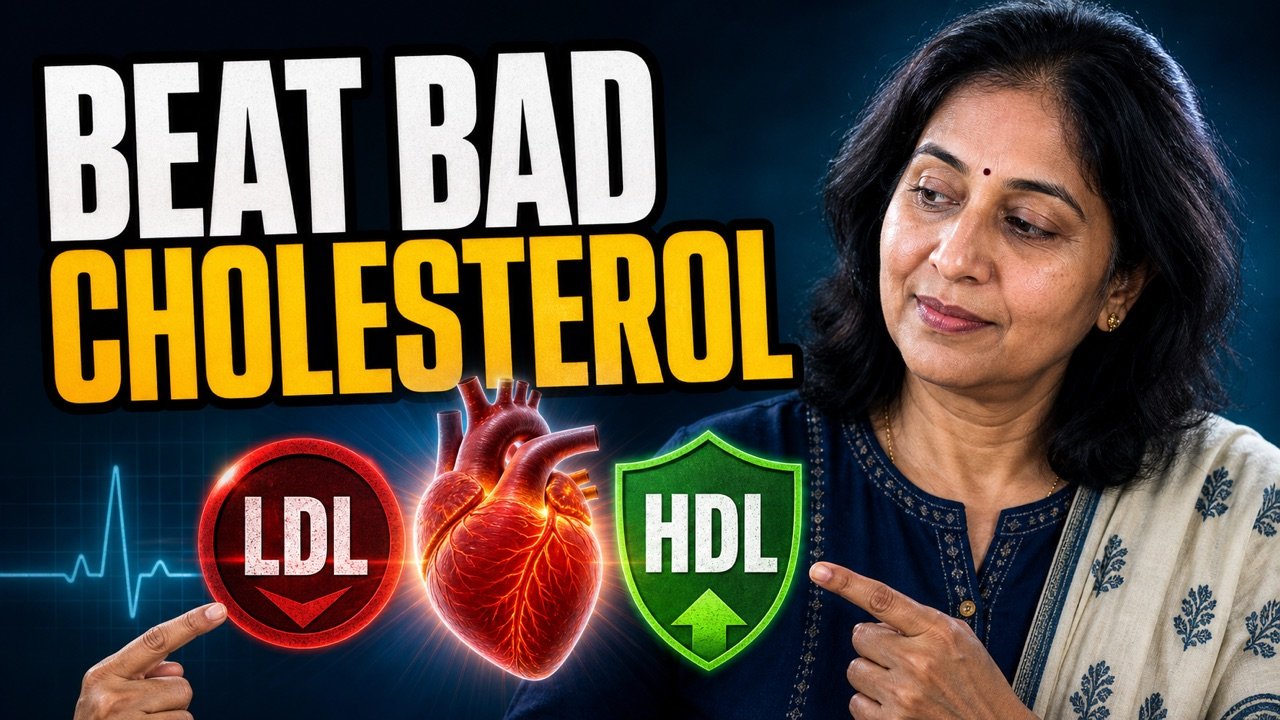
In short: Cholesterol travels in the blood as “packages” called lipoproteins. LDL is the “bad” kind that builds plaque in arteries; HDL is the “good” kind that clears it; triglycerides are another blood fat that adds risk. High LDL usually causes no symptoms until a heart attack or stroke, so a simple blood test matters. Because Indians develop heart disease early, target LDL levels are stricter — and lifestyle plus, when needed, medicines can lower it.
Key takeaways
- LDL is the “bad” cholesterol (deposits in arteries); HDL is the “good” (clears it away).
- High cholesterol is silent — the first sign can be a heart attack.
- Indian experts often advise stricter LDL targets because heart disease strikes early here.
- Lifestyle helps; higher-risk people often need statins — and shouldn’t stop them when they feel fine.
- Some high cholesterol is inherited (familial hypercholesterolaemia and Lp(a)).
Cholesterol is one of the most talked-about yet least understood numbers in heart health. Many people know they should keep it “low,” but few understand what cholesterol actually is, why some of it is harmful and some protective, or what their target numbers should be. Because high cholesterol usually causes no symptoms at all until it has already damaged the arteries, understanding and acting on your cholesterol is one of the most important, and most overlooked, steps you can take for your heart.
This article draws on the Heart Health India Foundation expert discussion What Are the Early Signs of High Cholesterol?. New to these topics? Start with our guide to understanding heart health.
What cholesterol is — and why some is “bad”
Cholesterol is a waxy, fat-like substance your body needs to build cells and make hormones. Your liver produces most of it, and some comes from food. Because cholesterol cannot dissolve in blood, it travels in packages called lipoproteins, and the type of package makes all the difference.
LDL (low-density lipoprotein) is the “bad” cholesterol. When there is too much LDL, it deposits in the walls of arteries, where it contributes to the fatty plaques that narrow and stiffen them. This is the central driver of heart attacks and strokes. HDL (high-density lipoprotein) is the “good” cholesterol, because it helps carry cholesterol away from the arteries back to the liver. A third number, triglycerides, measures another type of fat in the blood; high levels, often linked to excess sugar, refined carbohydrates, alcohol and obesity, add further risk. There is also lipoprotein(a), or Lp(a) — an inherited, particularly atherogenic particle that experts increasingly recommend testing at least once in adult life.
The silent danger of high cholesterol
Here is what makes high cholesterol so deceptive: it typically produces no early warning signs. You cannot feel high LDL. There is usually no pain, no fatigue, no obvious symptom — until, sometimes, the first “symptom” is a heart attack or stroke. Occasionally, very high or inherited cholesterol shows physical clues such as fatty deposits around the eyes or in tendons, but most people have no signs at all. This is precisely why a simple blood test — a lipid profile — is so valuable, and why cholesterol should be checked even when you feel perfectly well.
Know your numbers and your targets
Because Indians tend to develop heart disease about a decade earlier than Western populations, lipid experts in India often recommend stricter LDL targets than were used in the past. In broad terms, lower-risk individuals are generally advised to keep LDL below about 100 mg/dL, those at high risk below about 70 mg/dL, and those at very high risk — for example people who already have heart disease or diabetes with other risk factors — below about 55 mg/dL. Your personal target depends on your overall risk and should be set with your doctor. The important principle is that “normal for the lab” is not the same as “ideal for your heart” — the higher your risk, the lower your LDL should be.
How to beat bad cholesterol
For many people, lifestyle changes meaningfully improve cholesterol. Reduce saturated and trans fats — limit deep-fried foods, vanaspati and heavily processed snacks — and replace them with healthier fats from nuts, seeds and oils used in moderation. Increase soluble fibre from oats, legumes, fruits and vegetables, which helps remove cholesterol. Cut down on sugar and refined carbohydrates to lower triglycerides. Stay physically active, maintain a healthy weight, and stop tobacco, which lowers protective HDL.
For people at higher risk, lifestyle alone is often not enough, and cholesterol-lowering medicines — most commonly statins, sometimes with additional agents — are highly effective and well studied. Statins do more than lower numbers; they stabilise plaque and reduce the risk of heart attacks and strokes. If your doctor recommends them, it is because your risk warrants it. Do not stop them on your own because you “feel fine” — remember, high cholesterol has no symptoms, and neither does the protection a statin provides.
Common myths about cholesterol — and the truth
Cholesterol is surrounded by misinformation, and believing the myths can be dangerous. One common myth is that thin or young people don’t need to worry about cholesterol; in reality, cholesterol problems — including inherited ones — affect people of all sizes and ages, and Indians develop heart disease early. Another myth is that you would “feel” high cholesterol; as explained, it is silent until it causes a heart attack or stroke. Many people believe that once their cholesterol is normal on medication, they can stop the medicine — but stopping usually allows cholesterol and risk to climb straight back. There is also a widespread fear that statins are inherently harmful; while side effects can occur and should be discussed with your doctor, for people at genuine risk the proven benefit in preventing heart attacks and strokes is large and well established. Finally, some assume diet alone can always fix cholesterol; lifestyle helps significantly, but inherited and high-risk cases often genuinely need medication. Separating fact from fear lets you make decisions that actually protect your heart.
Familial hypercholesterolaemia and inherited cholesterol
Not all high cholesterol comes from diet and lifestyle. Some people inherit a condition called familial hypercholesterolaemia, in which the body handles LDL cholesterol poorly from birth, leading to very high levels and a sharply increased risk of early heart disease — sometimes in the thirties or forties, or even younger. It is more common than many realise and is frequently undiagnosed. Clues include very high LDL levels, a strong family history of early heart attacks, or physical signs such as cholesterol deposits in tendons or around the eyes. Lipoprotein(a), or Lp(a), is another inherited risk factor that runs in families and is not much affected by lifestyle. If heart disease strikes young in your family, it is worth discussing inherited cholesterol disorders and Lp(a) testing with your doctor — and, where relevant, screening close relatives, since early identification and treatment can prevent tragedy.
Making cholesterol-friendly eating practical in India
Translating cholesterol advice into the Indian kitchen is very doable. Lean toward more soluble fibre — oats, barley, legumes, fruits and vegetables — which actively helps remove cholesterol. Make whole grains and millets your staples instead of refined flour. Use oil with a measured, light hand and avoid repeatedly reused or deep-fried oil, and steer clear of vanaspati and packaged bakery items that may contain harmful trans fats. Enjoy nuts and seeds in modest amounts for their healthy fats. Treat sweets, fried snacks and sugary drinks as occasional rather than daily, since excess sugar raises triglycerides. None of this requires bland or alien food — India’s vegetables, dals, spices and whole grains form a naturally heart-friendly foundation. Combine this with regular activity, a healthy weight and no tobacco, and you give both your cholesterol and your heart their best chance.
Frequently Asked Questions
For most people there are none — high cholesterol is silent. That is why a blood lipid profile is essential, rather than waiting for symptoms that usually never come until damage is done.
LDL (“bad”) deposits cholesterol in artery walls and raises heart risk, while HDL (“good”) helps remove cholesterol from the arteries. The goal is lower LDL and adequate HDL.
It depends on your overall risk. Lower-risk people generally aim below about 100 mg/dL, high-risk below about 70, and very high-risk below about 55. Your doctor sets your individual target.
Lifestyle changes can significantly improve cholesterol for many people. However, those at higher risk often need medication such as statins for adequate protection. Both can work together.
Lp(a) is an inherited, especially harmful cholesterol particle. Many experts now recommend testing it at least once in adulthood to better understand your risk, particularly with a family history of early heart disease.
Making sense of your full lipid report
When you receive a lipid profile, it usually lists several numbers, and understanding them turns a confusing report into useful information. Total cholesterol is a broad figure that combines the different types and is less informative on its own. LDL cholesterol is the key “bad” number to lower, and the target depends on your overall risk. HDL cholesterol is the “good” type, and higher levels are generally protective. Triglycerides reflect another blood fat, often raised by excess sugar, refined carbohydrates, alcohol and obesity. Some reports also include non-HDL cholesterol, which captures all the harmful particles together and is a useful overall marker, and increasingly lipoprotein(a), an inherited risk factor worth checking at least once.
The crucial point is that these numbers must be interpreted in the context of your personal risk, not just against the lab’s reference range. A “normal-looking” LDL may still be too high for someone with diabetes or existing heart disease, for whom much lower targets apply. Rather than fixating on a single value, ask your doctor what your individual targets are, which numbers matter most for you, and what steps — dietary, lifestyle or medication — will help you reach them. Keeping copies of your lipid reports over time also lets you and your doctor see trends and judge whether your plan is working. An informed reading of your lipid profile is a powerful tool for protecting your heart.
The bottom line for protecting your heart
High cholesterol is one of the most important, most treatable and most silent of all heart-disease risk factors — and that silence is exactly why it is so often neglected. The single most powerful step you can take is simply to know your numbers through a lipid profile, including at least one lifetime check of lipoprotein(a). From there, lifestyle changes help everyone, while those at higher risk benefit greatly from cholesterol-lowering medicines that prevent heart attacks and strokes. For patients, the key is to understand your personal targets and to keep taking treatment even though you feel no symptoms. For families with early heart disease, inherited cholesterol disorders are worth investigating. And for people at risk, beating bad cholesterol now is a quiet but profound act of prevention. You cannot feel high cholesterol — so test, understand and act before it ever announces itself.
Join the HHIF Heart Health Community
Understanding and beating bad cholesterol is far simpler with experts to ask and a community to keep you on track. You don’t have to decode your reports alone.
Heart disease is India’s number one killer, and high cholesterol is one of its most common silent drivers — yet misinformation about diet and statins is everywhere. That’s why patient communities matter: they replace confusion with clear, expert-backed guidance and shared support.
The Heart Health India Foundation (HHIF) is India’s first patient-led heart health organisation. Members get real-time guidance from cardiologists and dietitians, myth-busting content, practical challenges, webinars and resources, and focused circles such as Nutrition & Cholesterol. Joining takes about two minutes, connects you to our WhatsApp and Facebook groups, and is 100% free, forever.
Join the HHIF Heart Health Community today »
Medical disclaimer
This article is for general education and awareness and is not a substitute for professional medical advice. Always consult a qualified doctor about your own heart health and before starting, stopping or changing any medication. If you or someone near you may be having a heart attack or other medical emergency, seek emergency care immediately.
Related reading from Heart Health India Foundation
- Understanding LDL, Lp(a) and triglycerides
- Cholesterol myths that hurt heart patients
- Can you be fit and still have high cholesterol?
- Good fats vs bad fats, explained
- Understanding heart health: the basics