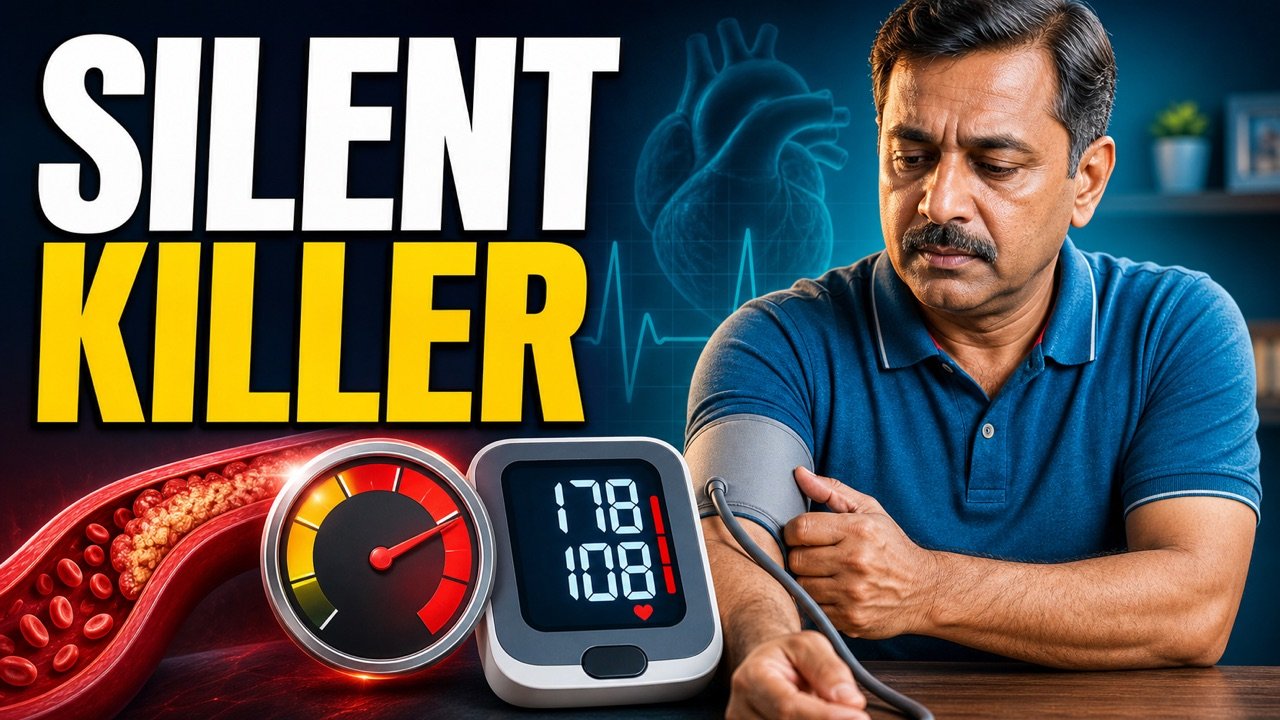
In short: High blood pressure (hypertension) is the “silent killer” — it usually causes no symptoms while quietly damaging your arteries, heart, brain, kidneys and eyes. Normal is around 120/80 mmHg; readings persistently at or above roughly 130–140/80–90 mmHg usually need attention. Because it has no symptoms, you must manage it by the numbers, not by how you feel — and few major heart risks are as controllable.
Key takeaways
- High blood pressure is usually symptom-free while it damages organs — manage it by the numbers.
- Normal ≈ 120/80 mmHg; persistently ≥130–140/80–90 usually warrants attention (your target is individual).
- It’s common and often undiagnosed in India, and drives early heart attacks and strokes.
- Cutting salt (pickles, papads, namkeen, processed food) is the highest-impact change for many Indians.
- Don’t stop BP medicine when readings improve — the improvement is the medicine working.
High blood pressure is often called the “silent killer,” and the name is earned. It usually causes no symptoms at all, yet day after day it quietly damages your arteries, heart, brain, kidneys and eyes. Many people only discover they have it after a heart attack, stroke or kidney problem has already begun. The empowering news, which patients and caregivers most want to hear, is that high blood pressure is one of the most controllable of all heart risks — once you know your numbers and act.
Explore more heart-health discussions on the Heart Health India Foundation YouTube channel. New to these topics? Start with our guide to understanding heart health.
What blood pressure actually is
Blood pressure is the force of blood pushing against the walls of your arteries. It is written as two numbers: the systolic (the higher number, the pressure when your heart beats) over the diastolic (the lower number, the pressure when your heart rests between beats). When this pressure stays too high over time — hypertension — the heart has to work harder and the arteries are damaged, accelerating the artery-narrowing process that leads to heart attacks and strokes.
Because there are usually no symptoms, the only way to know your blood pressure is to measure it. This is why we emphasise regular checks in our article on why heart screening saves lives — a simple measurement can reveal a major, treatable risk you would otherwise never feel.
Knowing your numbers
Blood pressure targets are best set with your doctor, but in general, normal is around 120/80 mmHg, and readings persistently at or above roughly 130–140/80–90 mmHg indicate higher risk that usually warrants attention. The exact threshold and target depend on your overall risk, age and other conditions — for example, people with diabetes or existing heart disease are often advised to keep their pressure lower. The key principle is that the higher your overall cardiovascular risk, the more important tight blood-pressure control becomes.
Home blood-pressure monitors can be valuable for tracking, but technique matters: sit quietly, feet flat, arm supported, and take readings at consistent times. A single high reading is not a diagnosis; patterns over time are what count.
Why it matters so much in India
High blood pressure is extremely common in India and frequently undiagnosed or under-treated. Combined with the fact that Indians tend to develop heart disease about a decade earlier than Western populations, uncontrolled hypertension is a major driver of premature heart attacks, strokes, heart failure and kidney disease. It also rarely travels alone — it often accompanies diabetes, unhealthy cholesterol and excess weight, each amplifying the others, as we discuss in diabetes and heart disease and weight and heart health.
How to control it
The good news is that blood pressure responds well to both lifestyle and, when needed, medicine. On the lifestyle side, the most powerful steps are reducing salt (go easy on pickles, papads, namkeen and processed foods, as covered in heart-healthy Indian cooking), staying physically active, maintaining a healthy weight, limiting alcohol (see alcohol and your heart), not smoking, managing stress (see the mind–heart connection), and getting good sleep (see sleep and your heart).
When lifestyle alone isn’t enough — which is common — blood-pressure medicines are safe, effective and often lifelong. There are several classes, and many also protect the heart and kidneys directly. As with all heart medicines, the silent nature of hypertension makes it tempting to stop treatment once readings improve; don’t. The improvement is the medicine working. Take it reliably and never stop without medical advice.
Measuring blood pressure the right way
Because decisions rest on the numbers, how you measure matters as much as the measurement itself. For an accurate reading, sit quietly for a few minutes first, with your back supported, feet flat on the floor and legs uncrossed, and your arm resting at heart level. Avoid caffeine, tobacco and exercise in the half hour before measuring, and don’t talk during the reading. Use a validated, properly sized arm cuff, and take a couple of readings a minute apart, recording the values. A single high reading on a stressful day is not a diagnosis — patterns over time are what count, which is why home monitoring and a simple log can be so useful. Bring your readings to appointments so your doctor sees the fuller picture rather than a single clinic measurement, which can be raised by the stress of the visit itself (the “white-coat” effect). If your readings are consistently high, or swing widely, share this with your doctor rather than adjusting medicines yourself. Good measurement turns blood pressure from an anxiety-provoking mystery into clear, actionable information — and it puts you, the patient, in an informed, active role in managing one of the most important and controllable of all heart risks.
What the research says
According to PubMed, hypertension is described as the most important modifiable risk factor for illness and death worldwide, and successful treatment reduces this burden — yet fewer than half of those affected are even aware they have it (Oparil and colleagues, Nature Reviews Disease Primers, 2018). The authors emphasise that lifestyle changes effectively lower blood pressure and that medicines such as ACE inhibitors, ARBs, calcium-channel blockers and thiazide diuretics are highly effective at preventing cardiovascular events. The practical takeaway for patients: get measured, and if your pressure is high, treat it seriously and consistently.
The damage you cannot feel
Part of what makes high blood pressure so dangerous is that the damage is cumulative and silent. Year after year, raised pressure stiffens and narrows arteries, enlarges and strains the heart muscle (which can lead to heart failure, see living with heart failure), weakens vessels in the brain (raising stroke risk, see stroke and the heart), harms the kidneys, and damages the small vessels of the eyes. None of this announces itself with symptoms until it is advanced. By the time a person “feels” their blood pressure — through a severe headache, breathlessness or a crisis — significant harm may already be done. This is exactly why measurement, not symptoms, must guide you, and why treating high blood pressure even when you feel perfectly well is so worthwhile.
Making blood-pressure control fit your life
Controlling blood pressure for the long term is about sustainable habits, not heroics. On the food side, reducing salt is the highest-impact change for many Indians — go easy on pickles, papads, namkeen, processed foods and added table salt, and rebuild flavour with spices, herbs, lemon and garlic, as we cover in heart-healthy Indian cooking. Add regular activity, a healthy weight, limited alcohol (alcohol and your heart), no tobacco, good sleep and stress management. If you monitor at home, keep a simple log and bring it to appointments so your doctor can fine-tune treatment.
When medicines are prescribed, take them at the same time daily and never stop them because your readings improved — the improvement is the medicine working. If you experience side effects, tell your doctor rather than quietly stopping; there are several classes of blood-pressure medicine, and the regimen can usually be adjusted to suit you. Consistent, well-tolerated, lifelong control is the goal, and it is very achievable.
What patients and caregivers ask
That is exactly why it’s called the silent killer. High blood pressure usually causes no symptoms while quietly damaging your arteries and organs. Feeling fine does not mean your pressure is fine — only measurement tells you.
Usually not. Normal readings on treatment mean the medicine is working. Stopping it typically lets pressure climb back up. Any change should be made with your doctor.
Often yes, but not always — some people with mild hypertension control it through lifestyle, and others reduce doses over time under guidance. Either way, lifelong treatment to prevent strokes and heart attacks is a worthwhile trade.
A lot. Excess salt raises blood pressure, and much of our intake comes from pickles, papads, namkeen and processed foods. Cutting back — and rebuilding flavour with spices and herbs — genuinely helps.
Both give useful information; readings can vary with setting and stress. Use a good technique at home, track patterns over time, and share them with your doctor rather than relying on any single reading.
Some people with mild hypertension control it through lifestyle changes and may reduce medication under medical supervision. Many need lifelong treatment. Never stop or reduce your medicine on your own — discuss any change with your doctor, who can adjust it safely based on your readings.
Staying reasonably hydrated is sensible, but the bigger dietary lever for blood pressure is salt, not water. Cutting back on salty foods like pickles, papads and packaged snacks usually does far more for your blood pressure than changing how much you drink.
The bottom line on the silent killer
High blood pressure earns its grim nickname because it does its damage silently, year after year, with no symptoms to warn you — until a heart attack, stroke, heart failure or kidney problem reveals it. That is precisely why it must be managed by the numbers, not by how you feel, and why treating it even when you feel perfectly well is so worthwhile. The encouraging truth is that few major heart risks are as controllable as this one. Measure it properly and regularly, know your target with your doctor, and act: reduce salt, stay active, keep a healthy weight, limit alcohol, don’t smoke, sleep well, and manage stress. When medicines are needed, take them at consistent times, never stop them because your readings improved, and report side effects so the regimen can be adjusted rather than abandoned. Home monitoring with a simple log turns an anxiety-provoking mystery into clear, actionable information and puts you in an active, informed role. Controlling your blood pressure is one of the single most powerful, lowest-cost things you can do for your heart and brain over a lifetime — quiet, consistent protection against a quiet, persistent threat.
References (peer-reviewed)
Sources retrieved from PubMed:
Oparil S, Acelajado MC, Bakris GL, et al. Hypertension. Nat Rev Dis Primers. 2018;4:18014.
Teo KK, Rafiq T. Cardiovascular Risk Factors and Prevention: A Perspective From Developing Countries. Can J Cardiol. 2021;37(5):733–743.
Join the HHIF Heart Health Community
Controlling blood pressure is a long-term habit, and it’s easier to stay on track with reliable guidance and a supportive community. You don’t have to manage it alone.
Heart disease is India’s number one killer, and uncontrolled high blood pressure is one of its biggest, most silent drivers. That’s why patient communities matter: they turn a scary number into a clear, supported plan.
The Heart Health India Foundation (HHIF) is India’s first patient-led heart health organisation. Members get real-time guidance from cardiologists and dietitians, myth-busting content, habit-building challenges, webinars and resources, and a community that keeps you motivated. Joining takes about two minutes, connects you to our WhatsApp and Facebook communities, and is 100% free, forever.
Join the HHIF Heart Health Community today »
Medical disclaimer
This article is for general education and awareness and is not a substitute for professional medical advice. Always consult a qualified doctor about your own heart health and before starting, stopping or changing any medication. If you or someone near you may be having a heart attack or other medical emergency, seek emergency care immediately.
Related reading from Heart Health India Foundation
- Why some Indians don’t respond to BP medicines
- Why “I don’t feel symptoms” becomes dangerous
- Hidden salt sources in everyday Indian foods
- Why reducing salt is essential for heart health
- Understanding heart health: the basics