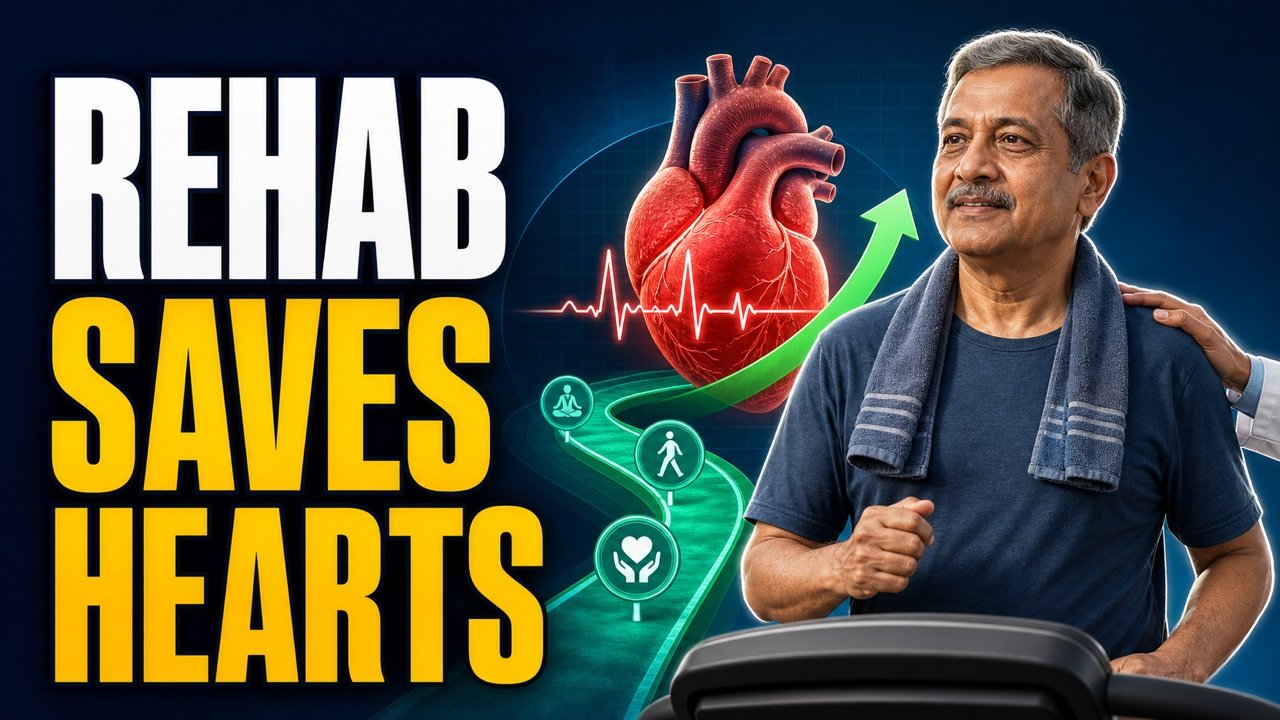
In short: Cardiac rehabilitation is a structured, medically supervised programme that helps you recover after a heart attack, bypass, angioplasty or heart-failure diagnosis — and lowers the risk of another event. It combines supervised exercise, education, risk-factor management, nutrition counselling, tobacco-cessation support and emotional support. It’s guideline-recommended and linked to fewer hospital readmissions and better survival, yet remains underused in India.
Key takeaways
- Cardiac rehab is far more than exercise — it’s a comprehensive, supervised programme.
- It is guideline-recommended and linked to fewer readmissions and better survival.
- It rebuilds confidence, replacing the fear of exertion after a cardiac event.
- It’s underused in India — ask your team about it before you leave hospital.
- Home-based and digital rehab can reach those who can’t attend in person.
After a heart attack, bypass surgery, angioplasty or a heart-failure diagnosis, most patients are focused on one question: how do I recover and prevent this from happening again? The single most effective, evidence-backed answer is often the most overlooked — cardiac rehabilitation. Despite strong evidence that it improves recovery, reduces hospital readmissions and can improve survival, cardiac rehab remains underused in India. Understanding what it is, and why it matters, could transform your recovery.
This article draws on the Heart Health India Foundation expert discussion Cardiac Rehabilitation. New to these topics? Start with our guide to understanding heart health.
What cardiac rehabilitation actually is
Cardiac rehabilitation is a structured, medically supervised programme designed to help people recover from cardiac events and reduce the risk of future ones. It is far more than “doing some exercise.” A good programme brings together several core components: supervised, individualised exercise training; education about your heart condition and medicines; risk-factor management for blood pressure, cholesterol, diabetes and weight; nutritional counselling; tobacco cessation support; and psychological and emotional support to address the anxiety and depression that often follow a cardiac event. A team that may include cardiologists, physiotherapists, dietitians and counsellors tailors the programme to your needs and monitors you as you progress.
The evidence: why it matters so much
Cardiac rehabilitation is not a “nice extra” — it is a guideline-recommended part of cardiac care backed by strong evidence. Studies have shown that attending cardiac rehabilitation after a major cardiac event is associated with meaningful reductions in cardiovascular mortality and in hospital readmissions, alongside better fitness, mood and quality of life. International cardiology guidelines give it a high level of recommendation for secondary prevention. In short, rehab helps people not only feel better but live longer and stay out of hospital — a remarkable return for a programme that also rebuilds confidence and independence.
What to expect in a programme
A typical programme begins with an assessment of your condition, fitness and risk factors, after which a personalised plan is created. Exercise sessions are supervised and gradually progressed, often with monitoring, so you learn how to be active safely and rebuild stamina without fear. Alongside exercise, you receive education and practical coaching on diet, medicines, stress and lifestyle. Programmes are commonly delivered over several weeks, and increasingly, where in-person rehab is hard to access, supervised home-based and technology-assisted models are being used to widen reach.
One of the most valuable, less tangible benefits is psychological. Many patients leave hospital frightened to exert themselves, unsure what is safe. Cardiac rehab replaces that fear with knowledge and confidence, which is itself protective — confident patients move more, follow their plans and recover better.
Overcoming barriers in India
Despite its benefits, cardiac rehab is underused, partly due to limited availability, cost, distance, low awareness and the assumption that recovery means simply resting at home. If a formal programme is not accessible to you, ask your cardiac team for a structured, written recovery and exercise plan, and consider supervised or home-based options and reputable digital resources. Crucially, do not assume that being discharged means your recovery work is done — the weeks after a cardiac event are when structured rehabilitation does the most good. Ask your doctor about cardiac rehabilitation before you leave the hospital.
The five core components explained
It is worth understanding the distinct pillars that make cardiac rehabilitation so effective, because together they address every dimension of recovery. The first is medically supervised exercise training, individualised to your condition, which rebuilds fitness safely and teaches you what activity feels right. The second is education, helping you understand your heart condition, your medicines and your warning signs, so you can manage your health confidently. The third is risk-factor management — actively working to control blood pressure, cholesterol, blood sugar and weight, which targets the root causes of heart disease. The fourth is lifestyle and nutritional counselling, including dietary guidance and tobacco-cessation support, translating knowledge into daily habits. The fifth, often the most overlooked, is psychological and emotional support, addressing the anxiety, depression and loss of confidence that frequently follow a cardiac event. Delivered together, these components do far more than any single intervention alone — which is precisely why comprehensive cardiac rehabilitation produces such meaningful improvements in survival, readmissions and quality of life.
From fear to confidence: the psychological transformation
Perhaps the most underappreciated benefit of cardiac rehabilitation is psychological. After a heart attack or surgery, many patients are gripped by fear — afraid that any exertion might trigger another event, unsure what their body can safely handle, and anxious about the future. This fear is itself harmful, leading people to avoid the very activity that would strengthen their hearts, withdraw socially, and slide into low mood. Cardiac rehab directly counters this. Exercising in a monitored, supportive environment, with professionals reassuring you and your own progress visible week by week, rebuilds trust in your body and a sense of control. Patients often describe leaving rehab not just fitter but transformed in mindset — from frightened survivors into confident managers of their own health. This restored confidence ripples outward, improving adherence to medicines, willingness to stay active, and overall quality of life. Healing the mind, in this sense, is part of healing the heart.
Making the most of your recovery, with or without formal rehab
Whether or not a formal programme is available to you, you can embrace the principles of cardiac rehabilitation in your own recovery. If you can access a programme, attend consistently and engage fully — ask questions, follow the exercise and lifestyle guidance, and use the educational sessions to become an expert in your own condition. If a centre is not within reach, ask your cardiac team for a structured, written recovery plan covering safe activity progression, diet, medicines, risk-factor targets and warning signs, and consider supervised home-based or reputable digital options. Either way, treat the weeks and months after a cardiac event as an active project, not a passive wait. Build gradual activity, control your risk factors, take your medicines reliably, tend to your emotional health, and lean on family and community for support. Recovery is not something that simply happens to you — it is something you actively build, and cardiac rehabilitation gives you the tools and confidence to build it well.
Frequently Asked Questions
People recovering from a heart attack, bypass surgery, angioplasty/stenting, heart failure and certain other heart conditions typically benefit. Your cardiologist can confirm whether it’s right for you.
No. It combines supervised exercise with education, risk-factor management, nutrition counselling, tobacco cessation and emotional support — a comprehensive programme addressing the whole person.
Evidence shows that attending cardiac rehabilitation after a major cardiac event is associated with reduced cardiovascular mortality and fewer hospital readmissions, along with better fitness and quality of life.
Programmes commonly run over several weeks, with sessions progressing as you improve. The exact duration varies by programme and individual needs.
Ask your cardiac team for a structured written recovery and exercise plan, and explore supervised home-based or technology-assisted options. Some rehabilitation guidance is far better than none.
Home-based and digital cardiac rehabilitation
A major barrier to cardiac rehabilitation in India is access — many people live far from a rehab centre, cannot easily travel repeatedly, or find that local programmes are scarce or full. Encouragingly, home-based and technology-assisted cardiac rehabilitation has emerged as a valuable alternative, widening the reach of this life-saving care. In these models, patients follow a structured, individualised programme at home, with guidance and monitoring provided remotely — through phone or video consultations, wearable devices, apps, or regular check-ins with the rehab team. Evidence suggests that well-designed home-based programmes can be effective for many suitable patients, bringing the core benefits of rehabilitation to those who could not otherwise attend in person.
If a centre-based programme is not practical for you, ask your cardiac team whether a home-based or hybrid option is suitable and safe for your condition, since some higher-risk patients still benefit from initial supervised sessions. Even where a formal programme is unavailable, you can apply rehabilitation principles at home with a clear written plan covering safe, progressive activity, risk-factor control, diet, medicines and warning signs, supplemented by reputable educational resources and, ideally, periodic professional review. The essential message is that distance or limited local services should not mean missing out on recovery support altogether. Cardiac rehabilitation, in whatever form you can access it, is too valuable to skip — and increasingly, technology is helping bring it within reach of more people than ever.
Is home-based cardiac rehabilitation as good as going to a centre? For many suitable patients, well-designed home-based or technology-assisted rehabilitation can deliver much of the benefit, with remote guidance and monitoring. Some higher-risk patients still benefit from initial supervised sessions, so ask your cardiac team what is safe and appropriate for you.
When should cardiac rehabilitation start after a cardiac event? It typically begins soon after a cardiac event or procedure, often starting with gentle activity in hospital and progressing through an outpatient programme. Ask your doctor about cardiac rehabilitation before you leave the hospital so you can start at the right time.
The bottom line on recovery
Cardiac rehabilitation is one of the best-kept secrets of heart care — guideline-recommended, backed by strong evidence, and yet badly underused in India. It is far more than exercise: a comprehensive programme combining supervised activity, education, risk-factor control, nutrition, tobacco cessation and emotional support, which together reduce readmissions, improve quality of life and can improve survival. Perhaps its greatest gift is transforming frightened survivors into confident managers of their own health. For patients, the message is to ask about cardiac rehabilitation before leaving hospital and to engage fully if a programme is available. Where centre-based rehab is out of reach, home-based and digital options, or at least a structured written plan from your cardiac team, can bring much of the benefit within reach. Recovery is not a passive wait but an active project — and cardiac rehabilitation gives you the tools, knowledge and confidence to build it well.
Join the HHIF Heart Health Community
Recovery is a journey best taken with expert guidance and fellow patients who’ve walked it before. You don’t have to rebuild your strength and confidence alone.
Heart disease is India’s number one killer, and too many patients are discharged without the structured support that rehabilitation provides. That’s why patient communities matter: they fill the gap with reliable, expert-backed guidance and shared encouragement.
The Heart Health India Foundation (HHIF) is India’s first patient-led heart health organisation. Members get real-time guidance from cardiologists, physiotherapists and dietitians, myth-busting content, recovery-focused challenges, webinars and resources, and supportive circles such as Fitness After Surgery and Emotional Recovery After a Heart Attack. Joining takes about two minutes, connects you to our WhatsApp and Facebook groups, and is 100% free, forever.
Join the HHIF Heart Health Community today »
Medical disclaimer
This article is for general education and awareness and is not a substitute for professional medical advice. Always consult a qualified doctor about your own heart health and before starting, stopping or changing any medication. If you or someone near you may be having a heart attack or other medical emergency, seek emergency care immediately.
Related reading from Heart Health India Foundation
- Recovery after bypass surgery: what to expect
- When and how to start activity after heart surgery
- Safe exercise for heart patients
- Warning signs after heart surgery you should never ignore
- Understanding heart health: the basics