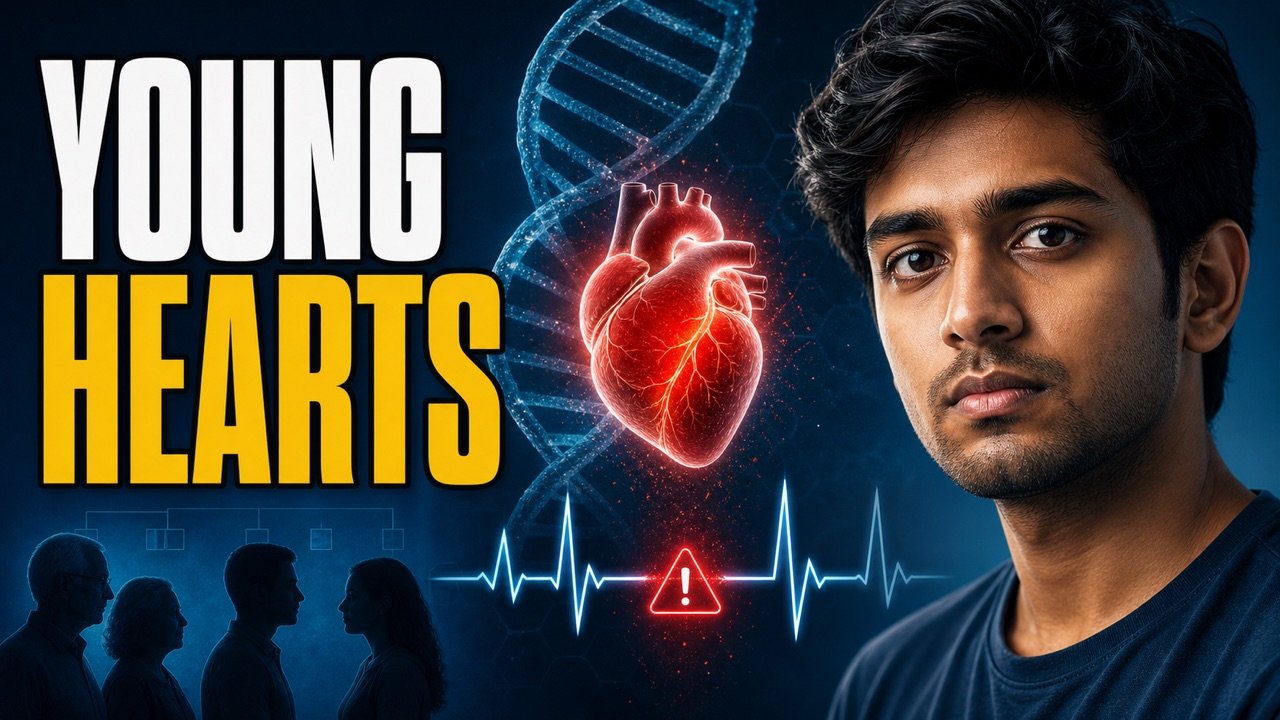
In short: Sudden cardiac arrest is when the heart abruptly stops pumping and the person collapses — different from a heart attack (a blocked artery). In young people it is often caused by inherited heart conditions such as cardiomyopathies or rhythm disorders. Warning signs — fainting during exercise, unexplained palpitations, or a family history of young sudden death — deserve evaluation. Bystander CPR and an AED save lives.
Key takeaways
- Cardiac arrest is the heart suddenly stopping — not the same as a heart attack.
- In the young it is often inherited (cardiomyopathies, rhythm disorders).
- A family history of young sudden death is a powerful clue.
- Fainting during exercise always deserves evaluation.
- Bystander CPR and an AED dramatically improve survival.
Few things are as shocking as a young, apparently fit person collapsing suddenly from cardiac arrest. We expect heart disease to strike later in life, so when it claims someone in their twenties or thirties — an athlete, a gym-goer, a healthy-looking professional — it feels inexplicable. Increasingly, these tragedies in India have drawn attention to a hidden factor: inherited, genetic heart conditions. Understanding sudden cardiac arrest in young adults can save lives, because many of these conditions are detectable and, once known, manageable.
This article draws on the Heart Health India Foundation expert discussion Understanding LMNA Cardiomyopathy: The Hidden Genetic Threat Behind Young-Age Cardiac Arrest. New to these topics? Start with our guide to understanding heart health.
How sudden cardiac arrest differs from a heart attack
These two terms are often confused. A heart attack occurs when blood flow to part of the heart muscle is blocked, usually by a clot in a narrowed artery. Sudden cardiac arrest is an electrical malfunction in which the heart abruptly stops pumping effectively, causing collapse and loss of consciousness within seconds. A heart attack can trigger a cardiac arrest, but in young people the cause is often different. Whereas older adults usually suffer arrests due to coronary artery disease, sudden cardiac arrest in the young more often stems from structural or electrical heart conditions — many of them inherited.
The genetic conditions behind young sudden cardiac arrest
Several inherited disorders can cause a young, healthy-seeming heart to fail without warning. The cardiomyopathies — diseases of the heart muscle — are among the most important. Hypertrophic cardiomyopathy, in which the heart muscle becomes abnormally thick, is one of the most common causes of sudden cardiac death in the young. Dilated and arrhythmogenic cardiomyopathies, including forms caused by mutations such as those in the LMNA gene, can also weaken the heart or disturb its rhythm. In addition, inherited arrhythmia syndromes — electrical disorders such as long QT syndrome and others — can cause dangerous rhythms in people with structurally normal-looking hearts.
A crucial feature of these conditions is that they often run in families and may give no symptoms until a catastrophic event. Research in India and globally has highlighted that family history is one of the most powerful clues: a positive history of sudden, unexplained death at a young age can identify a large share of people with inherited heart disease. This is why one tragedy in a family should prompt evaluation of relatives, not just grief.
Warning signs that deserve attention
While some affected people have no symptoms, certain signs should never be ignored, especially in young people and athletes: fainting or near-fainting during exertion or excitement, chest pain or undue breathlessness with exercise, palpitations or a racing/irregular heartbeat, unexplained seizures, or a family history of sudden cardiac death, drowning or unexplained accidents in young relatives. Any of these warrants medical evaluation by a cardiologist. Fainting during exercise in particular should always be taken seriously and investigated.
Screening, prevention and the role of CPR
Many inherited heart conditions can be detected through evaluation that may include an ECG, an echocardiogram and, where appropriate, genetic testing and specialist assessment. When a condition is identified, treatments — from medicines and activity guidance to implantable defibrillators in selected high-risk patients — can dramatically reduce the danger. Relatives of someone diagnosed with, or lost to, an inherited heart condition should discuss cascade screening with a cardiologist.
There is also a vital community dimension. Because sudden cardiac arrest kills within minutes, immediate bystander CPR and rapid use of an automated external defibrillator (AED) can be the difference between life and death. Learning CPR, and supporting wider access to AEDs in schools, gyms and public spaces, is something everyone can do to make young sudden cardiac arrest more survivable.
A note of balance: sudden cardiac arrest in the young is frightening but, in absolute terms, uncommon. The goal is not panic but awareness — recognising warning signs, taking family history seriously, and seeking evaluation when red flags appear.
The role of lifestyle and other triggers in the young
While inherited conditions are central to sudden cardiac arrest in the young, they are not the whole story, and lifestyle factors increasingly contribute too. Coronary artery disease — the artery-narrowing usually associated with older adults — is appearing earlier in India, driven by smoking, diabetes, high cholesterol, high blood pressure, stress and inactivity, and it can cause heart attacks and arrests in people far younger than expected. Other triggers deserve caution as well. The misuse of anabolic steroids and certain performance- or physique-enhancing substances has been linked to serious cardiac harm in young, fitness-focused individuals. Stimulant drugs, excessive energy-drink and stimulant use, and extreme, unaccustomed exertion without proper conditioning can also stress a vulnerable heart. None of this means that exercise is dangerous — regular, sensible activity is profoundly heart-protective — but it does mean that extreme regimes, unsupervised supplements and ignoring warning symptoms are genuine risks worth avoiding.
Why family history is such a powerful clue
If there is one message that can save lives, it is to take family history seriously. Many inherited heart conditions are passed down through families, and a single event — a young relative who died suddenly and unexpectedly, drowned without clear cause, or died in an unexplained single-vehicle accident — can be the first visible sign of a condition that other family members also carry, silently. A positive family history of sudden, unexplained death at a young age can identify a substantial share of people with inherited heart disease. This is why doctors ask about family history, and why one tragedy should prompt evaluation of surviving relatives rather than being quietly mourned and set aside. If your family has experienced such a loss, gently raising it with a cardiologist — and asking whether you and other relatives should be assessed — is a powerful, proactive step. Knowledge here is not a burden; it is the key to prevention.
Screening athletes and active young people
There is growing attention worldwide, and increasingly in India, to screening young athletes and very active individuals, since intense exertion can unmask certain hidden heart conditions. Approaches vary, but the core idea is to identify warning signs — symptoms such as fainting during exertion, a family history of young sudden death, or abnormalities on examination — that warrant further evaluation by a cardiologist before clearing someone for intense competitive sport. If you or your child trains intensively, it is reasonable to discuss with a doctor whether any pre-participation evaluation is advisable, particularly if there are symptoms or a concerning family history. The aim is not to discourage sport, which is overwhelmingly beneficial, but to identify the small number of people for whom precautions or treatment could prevent a tragedy on the field. Combined with widespread CPR training and access to defibrillators where young people gather, such awareness can make sport both vigorous and safe.
Frequently Asked Questions
In the young it is often due to inherited structural or electrical heart conditions — such as cardiomyopathies and arrhythmia syndromes — rather than the artery blockages that dominate in older adults.
No. A heart attack is a blood-flow blockage, while sudden cardiac arrest is an electrical malfunction that stops the heart abruptly. A heart attack can sometimes trigger an arrest.
Often yes. Evaluation may include an ECG, echocardiogram and, where appropriate, genetic testing. Detecting a condition allows protective treatment and family screening.
People with warning symptoms (such as fainting during exercise) and relatives of anyone with a known inherited heart condition or a young sudden cardiac death should discuss screening with a cardiologist.
Immediate CPR and rapid use of an AED greatly improve survival. Learning CPR and supporting AED access in public spaces saves lives. This article discusses sudden cardiac death, which can be a distressing topic. If you have lost someone or feel anxious about your own risk, please speak with a doctor — and know that support is available.
Learning CPR and using a defibrillator
Because sudden cardiac arrest causes death within minutes unless treated immediately, what bystanders do in those first moments is often decisive — and this is something every one of us can prepare for. When someone collapses, is unresponsive and is not breathing normally, immediate hands-only CPR — pushing hard and fast in the centre of the chest — keeps blood flowing to the brain and heart until help arrives, dramatically improving the chance of survival. You do not need to be a medical professional; even imperfect CPR is vastly better than doing nothing, and the worst mistake is hesitation. Calling for emergency help and starting chest compressions without delay can save a life, including that of a young, healthy-seeming person.
An automated external defibrillator, or AED, makes survival even more likely. These devices are designed for ordinary people to use: they give clear spoken instructions and will only deliver a shock if the heart’s rhythm needs it. Wider availability of AEDs in schools, gyms, offices, places of worship and public spaces — together with people trained and willing to use them — could prevent many young cardiac deaths. Learning basic CPR through a short course, encouraging your workplace or community to install AEDs, and overcoming the fear of “doing it wrong” are concrete, powerful steps. In a sudden cardiac arrest, a prepared bystander is often the difference between tragedy and survival.
The bottom line on a frightening but preventable tragedy
Sudden cardiac arrest in young people is rare in absolute terms, yet devastating — and far more preventable than most people realise. The hidden role of inherited heart conditions means that family history is a powerful clue, and that one tragedy should prompt evaluation of surviving relatives rather than silent grief. Warning signs such as fainting during exertion deserve to be taken seriously and investigated. Lifestyle factors, from smoking and unmanaged risk factors to misused supplements and extreme exertion, add further preventable risk. And because arrest kills within minutes, widespread CPR training and access to defibrillators can turn many tragedies into survivals. The message is not fear but empowered awareness: know your family history, heed warning symptoms, seek evaluation when red flags appear, and be ready to act. For patients, families and communities alike, knowledge and preparation are the most powerful protections we have.
Join the HHIF Heart Health Community
Questions about inherited heart risk and screening are weighty, and you shouldn’t have to face them alone. Reliable information and shared support make all the difference.
Heart disease is India’s number one killer, and awareness of inherited and young-onset heart conditions is still low — leaving families confused and isolated. That’s why patient communities matter: they bring expert-backed clarity and compassionate support together.
The Heart Health India Foundation (HHIF) is India’s first patient-led heart health organisation, with dedicated awareness work on sudden cardiac death and inherited heart conditions. Members get real-time guidance from cardiologists and other experts, myth-busting content, awareness resources, webinars, and a caring community. Joining takes about two minutes, connects you to our WhatsApp and Facebook groups, and is 100% free, forever.
Join the HHIF Heart Health Community today »
Medical disclaimer
This article is for general education and awareness and is not a substitute for professional medical advice. Always consult a qualified doctor about your own heart health and before starting, stopping or changing any medication. If you or someone near you may be having a heart attack or other medical emergency, seek emergency care immediately.
Related reading from Heart Health India Foundation
- Sudden arrhythmic death syndrome (SADS)
- Unravelling LMNA cardiomyopathy (HHIF webinar)
- 5 insights from the Global Cardiomyopathy Patient Council
- Why young adults shouldn’t skip annual health tests
- Understanding heart health: the basics
Authoritative sources
Read next: Our full guide to sudden cardiac death in India covers the warning signs, what a family should do in the first days after a sudden death, and why screening blood relatives saves lives.